

SGLT2 Inhibitors: Cardiorenal Mechanisms How a glucose-lowering drug became a foundational heart and kidney therapy

Authors

  • Dr Ashutosh Mishra English Author

Keywords:

SGLT2 inhibitors, Tubuloglomerular feedback, eGFR dip, Natriuresis/osmotic diuresis, Myocardial energetics, Anti-inflammatory/anti-fibrotic signalling, Heart failure outcomes, CKD progression

Abstract

Abstract
Sodium–glucose cotransporter 2 (SGLT2) inhibitors, originally developed for glucose lowering, have become foundational therapies for heart failure (HF) and chronic kidney disease (CKD). Renal effects center on restoration of tubuloglomerular feedback: increased distal sodium delivery causes afferent arteriolar vasoconstriction, lowers intraglomerular pressure and produces an early, modest eGFR “dip” that stabilizes and signals long-term nephroprotection rather than injury. Cardiorenal benefits arise from complementary hemodynamic and metabolic pathways, including natriuresis and osmotic diuresis (reducing plasma volume, blood pressure, and ventricular filling pressures), improved myocardial energetics (ketone utilization), anti-inflammatory and anti-fibrotic signalling, reduced uric acid and oxidative stress. These mechanisms operate largely independently of glucose lowering and explain efficacy in patients without diabetes. Large outcome trials show consistent reductions in HF hospitalization and cardiovascular death (relative risk reductions ~18–26%) and in CKD progression or cardiorenal death (~28–39%). SGLT2 inhibitors also lower acute kidney injury risk and slow chronic kidney disease progression across glycemic status. Clinicians should counsel patients about the expected initial eGFR dip and avoid premature discontinuation. Contemporary guidelines now recommend SGLT2 inhibitors as core cardioprotective and kidney-protective therapy, including first-line use in HFmrEF and HFpEF.
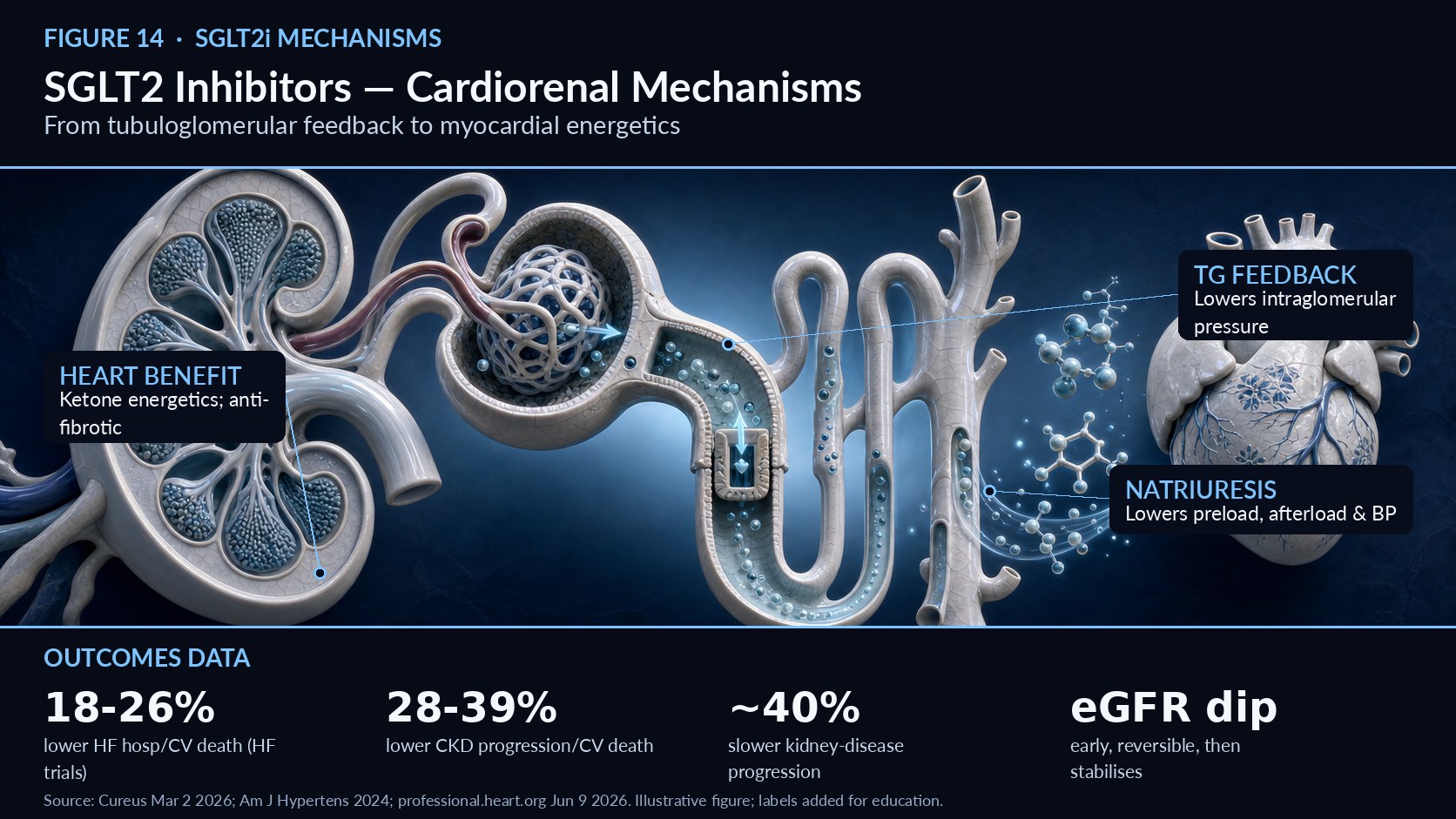

SGLT2 Inhibitors: Cardiorenal Mechanisms How a glucose-lowering drug became a foundational heart and kidney therapy   Figure 14. SGLT2 Inhibitors: Cardiorenal Mechanisms — mechanism overview (illustrative; labels added for education). SGLT2 inhibitors have moved far beyond glucose control, and understanding their mechanisms clarifies why. A key renal mechanism is restoration of tubuloglomerular feedback: increased sodium delivery to the macula densa triggers afferent arteriolar vasoconstriction, reducing intraglomerular pressure and curbing the maladaptive hyperfiltration that damages nephrons over time.1 This explains the characteristic early, modest eGFR “dip” seen after initiation. The dip stabilises over time and is followed by a slower long-term loss of kidney function—a hemodynamic signature of protection rather than injury, which clinicians should anticipate and not misinterpret as harm.1 The cardiac and systemic benefits arise through complementary pathways. Natriuresis and osmotic diuresis reduce plasma volume, blood pressure, and ventricular filling pressures, unloading both preload and afterload. Additional mechanisms include ketone-mediated improvements in myocardial energetics, anti-inflammatory and anti-fibrotic signalling, and reductions in uric acid and oxidative stress.1 The net effect is protection that is largely independent of glucose lowering. Outcomes data validate the biology. Across landmark trials, SGLT2 inhibitors reduced heart-failure hospitalisation or cardiovascular death by 18–26% (DAPA-HF HR 0.74; EMPEROR-Reduced HR 0.75; EMPEROR-Preserved HR 0.79; DELIVER HR 0.82) and reduced CKD progression or cardiovascular death by 28–39% (DAPA-CKD HR 0.61; EMPA-KIDNEY HR 0.72; CREDENCE HR 0.70).1 On top of standard care, they cut acute kidney injury risk by roughly 25% and slow kidney-disease progression by about 40%, with similar effects independent of type 2 diabetes.2 A useful clinical corollary is how to counsel patients about the initial eGFR dip. Anticipating it, explaining that it reflects reduced intraglomerular pressure rather than injury, and avoiding reflexive discontinuation are key to keeping patients on a therapy that pays off over years.1 The convergence of hemodynamic, metabolic, and anti-inflammatory mechanisms—largely independent of glucose lowering—also explains why benefit extends to patients without diabetes, a point the outcomes trials confirm and the guidelines now reflect.2 These mechanisms and outcomes underpin the drug class’s central role in the 2026 CKM guideline, which recommends SGLT2 inhibitors as cardioprotective and kidney-protective guideline-directed therapy and as first-line treatment in HFmrEF and HFpEF.3 For any CKM patient, the mechanistic story is now a clinical mandate. References 1. Beyond Glucose Control: SGLT2 Inhibitors in HF, CKD, and NAFLD, Cureus, March 2, 2026. https://pmc.ncbi.nlm.nih.gov/articles/PMC12952939/ 2. Mechanisms of Action of SGLT2 Inhibitors, Am J Hypertens, 2024. https://pmc.ncbi.nlm.nih.gov/articles/PMC11471837/ 3. 2026 CKM Guideline — Top Things to Know, professional.heart.org, June 9, 2026. https://professional.heart.org/en/science-news/2026-guideline-for-the-prevention-detection-evaluation-and-management-of-ckm-syndrome/top-things-to-know 4. Evidence on SGLT2 Inhibitors' Efficacy in Older and Frail Patients, J Clin Med, March 14, 2026. https://pmc.ncbi.nlm.nih.gov/articles/PMC13027104/ 5. KDIGO 2026 Diabetes and CKD Guideline Update Public Review Draft, March 2026. https://kdigo.org/wp-content/uploads/2026/03/KDIGO-2026-Diabetes-and-CKD-Guideline-Update-Public-Review-Draft-March-2026.pdf 6. A new guideline links care for heart, kidney and metabolic diseases, Science News, June 10, 2026. https://www.sciencenews.org/article/heart-diabetes-kidney-disease-treatment

Published

2026-07-11

How to Cite

SGLT2 Inhibitors: Cardiorenal Mechanisms How a glucose-lowering drug became a foundational heart and kidney therapy. (2026). Diabzen, 4(14), 28-29. https://thediabzen.com/index.php/d/article/view/56

Most read articles by the same author(s)

<< < 1 2 3