

Interdisciplinary Care and the CKM Coordinator Model A named point person to break down clinical silos and drive guideline-directed therapy

Authors

  • Dr Ashutosh Mishra english Author

Keywords:

CKM coordinator, Interdisciplinary care, Guideline-directed medical therapy, Care coordination, Therapeutic inertia, Multiorgan disease

Abstract

Abstract 
Background: Cardiovascular, kidney, and metabolic (CKM) conditions frequently coexist, producing overlapping morbidity that fragments care across specialties and settings. The 2026 CKM guideline responds by elevating team-based, interdisciplinary management and recommending a named CKM coordination point person to integrate care.

Intervention: The CKM coordinator model designates a single accountable clinician—often a nurse navigator, pharmacist, or care manager—who links patients, primary care, specialists (cardiology, nephrology, endocrinology), social services, and community health workers. Core tasks include arranging follow-up, reconciling and titrating guideline-directed medical therapy (GDMT), monitoring adherence and adverse effects, facilitating lifestyle interventions, and addressing social determinants that impede care.

Outcomes and benefits: Centralizing responsibility reduces therapeutic inertia and loss to follow-up, increases delivery of organ-protective therapies, and streamlines multidisciplinary decision-making. Coordinated workflows and shared care pathways improve efficiency and patient experience while enabling measurement of process and outcome metrics important to administrators.

Implementation considerations: Effective deployment requires role definition, training, electronic communication pathways, pharmacist involvement for medication review, and metrics for GDMT uptake and clinical outcomes. Challenges include resourcing, cross-disciplinary culture change, and interoperable records. Conclusion: The CKM coordinator model offers a practical, scalable strategy to translate guideline recommendations into measurable improvements for patients with complex, multisystem cardiometabolic disease.
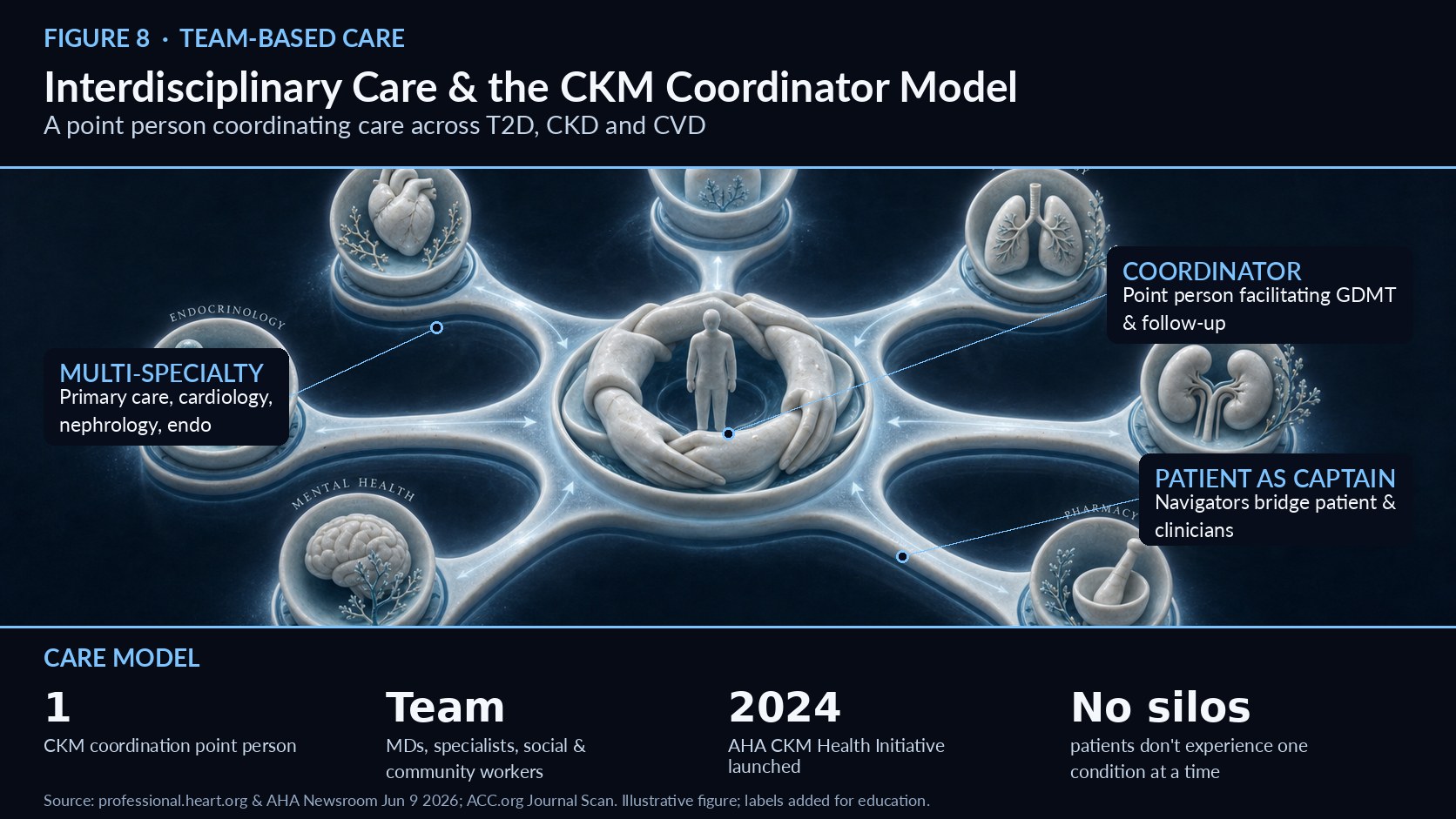

NEWSLETTER 8 Interdisciplinary Care and the CKM Coordinator Model A named point person to break down clinical silos and drive guideline-directed therapy   Figure 8. Interdisciplinary Care and the CKM Coordinator Model — mechanism overview (illustrative; labels added for education). Because CKM syndrome spans cardiology, nephrology, endocrinology, and primary care, the 2026 guideline makes interdisciplinary, team-based care a formal recommendation for patients with overlap among type 2 diabetes, CKD, and cardiovascular disease.1 The centrepiece of this model is a designated point person who coordinates the team, facilitates guideline-directed medical therapy (GDMT) implementation, and supports both patients and clinicians.1 The guideline is explicit that navigators or care coordinators improve care by coordinating between the patient, primary care, and specialty clinicians, and by ensuring follow-up—often the weakest link in fragmented systems.2 Coordinated interdisciplinary care with a “CKM coordination point person” is listed as a core recommendation, alongside attention to lifestyle behaviours across physical activity, nutrition, weight, blood pressure, blood sugar, and cholesterol.3 The composition of the team is deliberately broad: primary care doctors, specialists, social workers, and community health workers all contribute to streamlining care across the syndrome.4 This structure recognises that CKM patients face medical, behavioural, and social barriers simultaneously. Co-author Fatima Rodriguez framed the problem candidly: clinicians “operate from our own silos,” yet “people with CKM syndrome don’t experience one condition at a time,” and “the patient is team captain.”2 The coordinator model is the structural answer to that fragmentation. The coordinator model is also a practical answer to therapeutic inertia. When one named person owns follow-up and GDMT titration, patients are far less likely to fall through the cracks between a cardiology, nephrology, and endocrinology clinic that rarely share notes.2 The guideline pairs this structural fix with attention to the full set of modifiable behaviours—physical activity, nutrition, weight, blood pressure, blood sugar, and cholesterol—so that coordination is not merely administrative but drives measurable improvement across every CKM axis.3 This recommendation has strong institutional resonance. In 2024, the AHA launched the CKM Health Initiative to provide a path for patients, communities, and clinicians to improve diagnosis and treatment, giving the coordinator concept an operational home.2 For hospital administrators, the model translates directly into staffing and workflow design: defining a coordinator role, building shared care pathways, and tracking whether patients with multi-organ CKM disease actually receive the full complement of organ-protective therapies. Pharmacist-led review is a natural fit within such teams.6 References 1. 2026 CKM Guideline — Top Things to Know, professional.heart.org, June 9, 2026. https://professional.heart.org/en/science-news/2026-guideline-for-the-prevention-detection-evaluation-and-management-of-ckm-syndrome/top-things-to-know 2. New guideline reframes weight as health risk, AHA Newsroom, June 9, 2026. https://newsroom.heart.org/news/new-guideline-reframes-weight-as-health-risk-tied-to-diabetes-kidney-and-heart-conditions 3. First-Ever Guideline Addresses CKM Syndrome, ACC.org Journal Scan, June 9, 2026. https://www.acc.org/latest-in-cardiology/journal-scans/2026/06/08/17/44/first-ever-guideline-addresses-ckm-syndrome 4. A new guideline links care for heart, kidney and metabolic diseases, Science News, June 10, 2026. https://www.sciencenews.org/article/heart-diabetes-kidney-disease-treatment 5. First-ever guideline on CKM syndrome issued, AHA Newsroom, June 9, 2026. https://newsroom.heart.org/news/first-ever-guideline-on-cardiovascular-kidney-metabolic-syndrome-issued 6. Review of GLP-1 and Dual GLP-1/GIP receptor agonists, Am J Health Syst Pharm, June 2025 (PMID 40197714). https://pubmed.ncbi.nlm.nih.gov/40197714/

Downloads

Published

2026-07-07

How to Cite

Interdisciplinary Care and the CKM Coordinator Model A named point person to break down clinical silos and drive guideline-directed therapy. (2026). Diabzen, 4(8), 16-17. https://thediabzen.com/index.php/d/article/view/48

Most read articles by the same author(s)

<< < 1 2 3