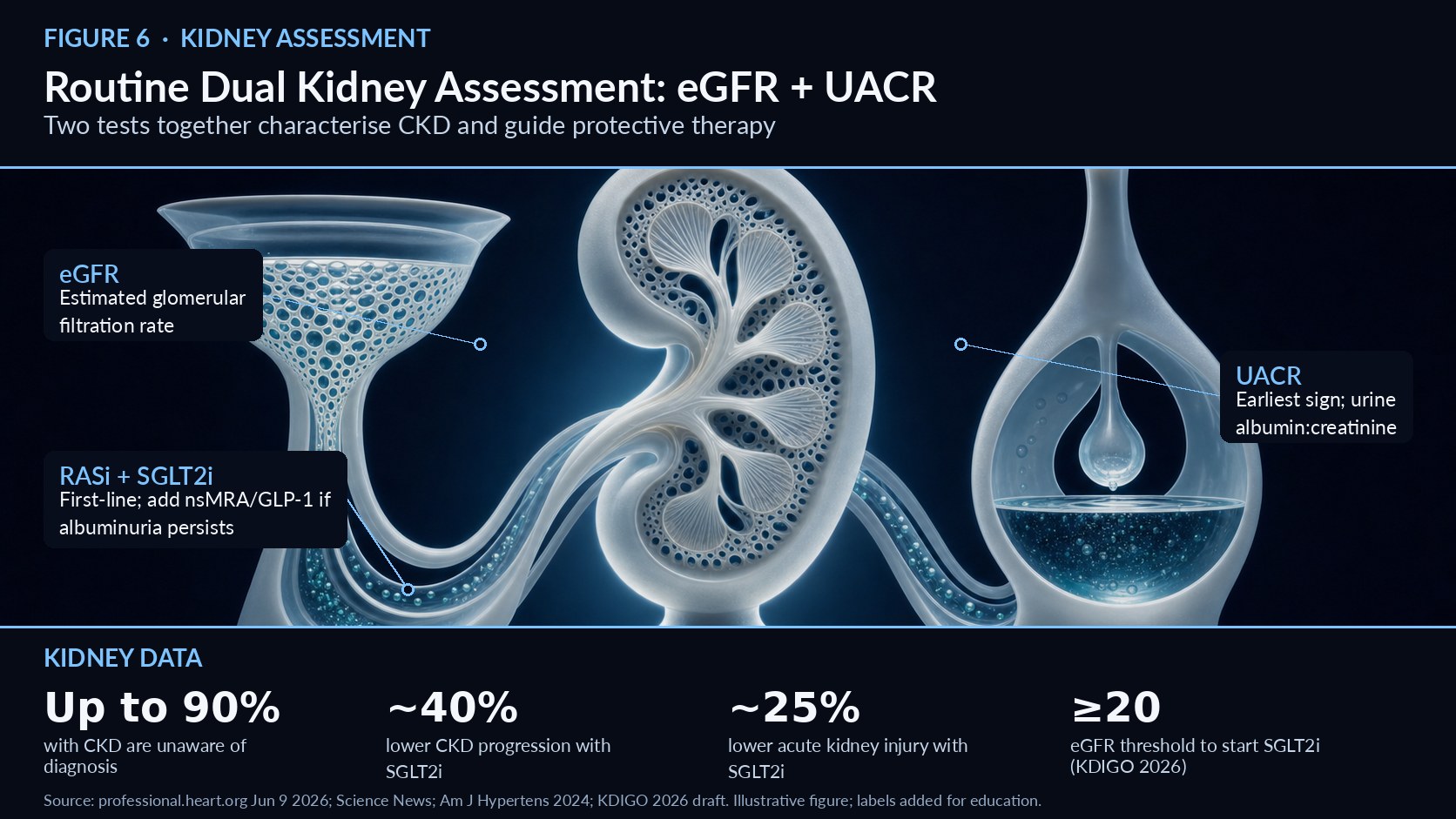

Routine Dual Kidney Assessment: eGFR + UACR Making albuminuria testing standard practice to catch CKM early
Keywords:
eGFR, UACR, dual kidney assessment, albuminuria screening, CKD detection, SGLT2 inhibitors, RAS inhibitors, nonsteroidal MRA, GLP‑1 therapy, CKM guideline, quality improvementAbstract
Abstract
Background: Up to 90% of people with chronic kidney disease (CKD) are unaware of their diagnosis because reliance on serum creatinine/eGFR alone misses early albuminuric disease. The 2026 CKM Guideline recommends routine dual kidney assessment (eGFR + UACR) to improve detection and guide organ‑protective therapy.
Objective: To summarise evidence supporting combined eGFR and UACR testing, describe how dual assessment informs staging and treatment decisions, and provide practical implementation strategies for primary care and health systems.
Methods: We review the complementary roles of eGFR (filtration capacity) and UACR (glomerular leak/endothelial injury), summarise outcome data linking albuminuria to cardiovascular and kidney risk, and outline the guideline‑aligned therapeutic sequence for CKD with type 2 diabetes or albuminuria: RAS inhibitors and SGLT2 inhibitors as first‑line, with addition of nonsteroidal mineralocorticoid receptor antagonists or GLP‑1‑based therapies when albuminuria persists. We highlight KDIGO and trial evidence supporting early intervention.
Results/Conclusions: Routine dual assessment increases early CKD detection, closes a large diagnostic gap, and directly enables timely initiation of evidence‑based, kidney‑ and cardioprotective therapies. Health systems can operationalise this recommendation with automatic UACR reflex orders for diabetic and hypertensive panels and by tracking UACR completion as a quality metric—an inexpensive, high‑yield step toward earlier staging and improved outcomes.