

Routine Dual Kidney Assessment: eGFR + UACR Making albuminuria testing standard practice to catch CKM early

Authors

  • Dr. Ashutosh Mishra MBBS, MD (Medicine), IMS BHU Fellowship in Diabetes (DFID) CMC Velliore, DMSc, Endocrinology (South Wales), UK Consultant Endocrinologist & Diabetologist English Author

Keywords:

eGFR, UACR, dual kidney assessment, albuminuria screening, CKD detection, SGLT2 inhibitors, RAS inhibitors, nonsteroidal MRA, GLP‑1 therapy, CKM guideline, quality improvement

Abstract

Abstract
Background: Up to 90% of people with chronic kidney disease (CKD) are unaware of their diagnosis because reliance on serum creatinine/eGFR alone misses early albuminuric disease. The 2026 CKM Guideline recommends routine dual kidney assessment (eGFR + UACR) to improve detection and guide organ‑protective therapy.

Objective: To summarise evidence supporting combined eGFR and UACR testing, describe how dual assessment informs staging and treatment decisions, and provide practical implementation strategies for primary care and health systems.

Methods: We review the complementary roles of eGFR (filtration capacity) and UACR (glomerular leak/endothelial injury), summarise outcome data linking albuminuria to cardiovascular and kidney risk, and outline the guideline‑aligned therapeutic sequence for CKD with type 2 diabetes or albuminuria: RAS inhibitors and SGLT2 inhibitors as first‑line, with addition of nonsteroidal mineralocorticoid receptor antagonists or GLP‑1‑based therapies when albuminuria persists. We highlight KDIGO and trial evidence supporting early intervention.

Results/Conclusions: Routine dual assessment increases early CKD detection, closes a large diagnostic gap, and directly enables timely initiation of evidence‑based, kidney‑ and cardioprotective therapies. Health systems can operationalise this recommendation with automatic UACR reflex orders for diabetic and hypertensive panels and by tracking UACR completion as a quality metric—an inexpensive, high‑yield step toward earlier staging and improved outcomes.
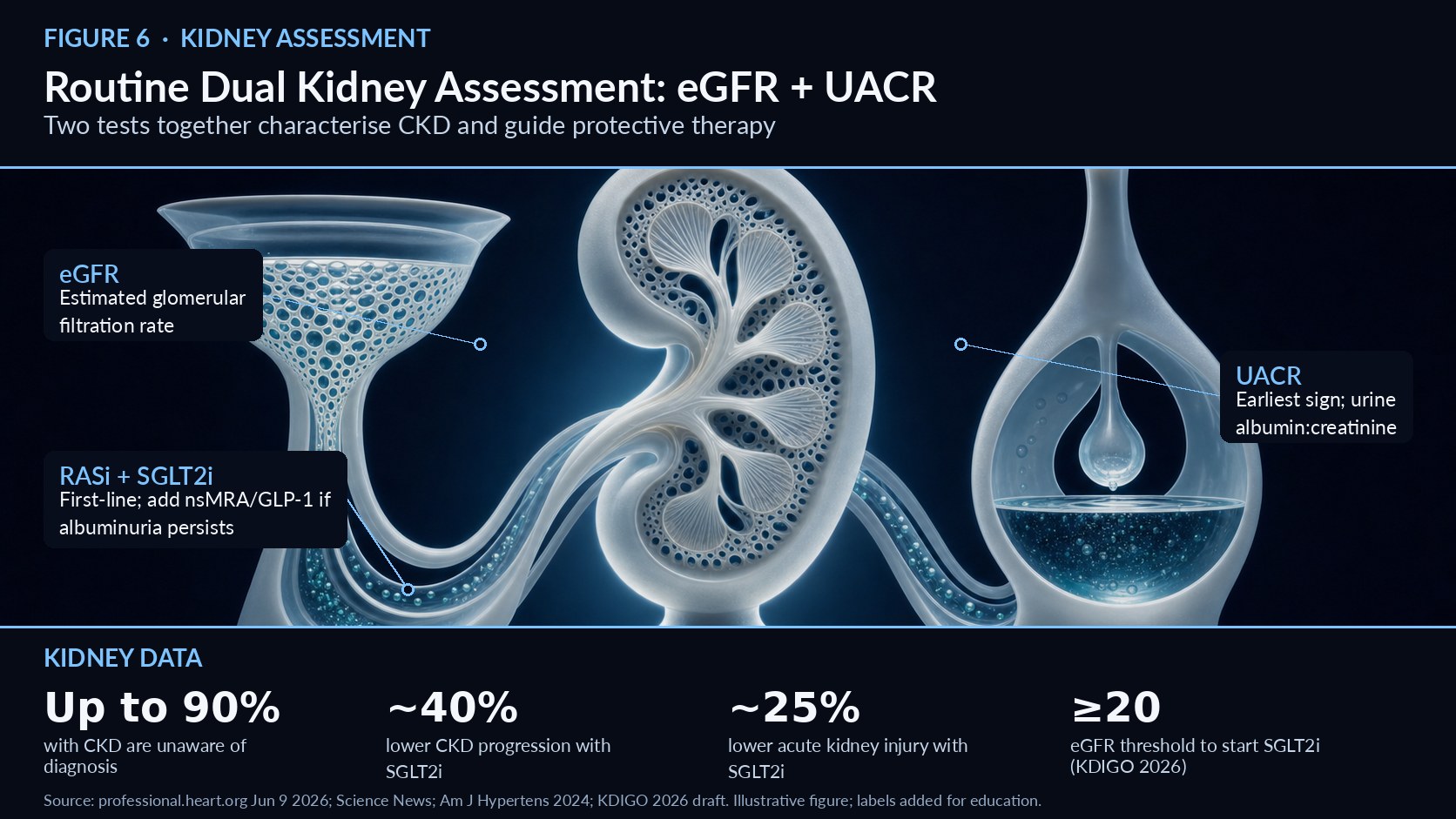

NEWSLETTER 6 Routine Dual Kidney Assessment: eGFR + UACR Making albuminuria testing standard practice to catch CKM early   Figure 6. Routine Dual Kidney Assessment: eGFR + UACR — mechanism overview (illustrative; labels added for education). One of the most operationally consequential recommendations of the 2026 guideline is deceptively simple: use both estimated glomerular filtration rate (eGFR) and urine albumin-to-creatinine ratio (UACR) to characterise chronic kidney disease and to guide therapies that confer both cardiovascular and kidney benefit.1 Relying on eGFR alone misses a large group of patients whose earliest kidney injury manifests as albuminuria. The clinical logic is clear. UACR often provides the earliest sign of kidney disease—frequently before filtration-rate testing becomes abnormal—so a normal creatinine can falsely reassure both clinician and patient.2 This matters enormously given that up to 90% of people with CKD are unaware of their diagnosis, a detection gap that routine dual assessment in primary care is designed to close.2 Once CKD is identified, the guideline sets a clear therapeutic sequence: for CKD with type 2 diabetes or with albuminuria, RAS inhibitors and SGLT2 inhibitors should be first-line, and if albuminuria persists, a nonsteroidal MRA or GLP-1-based therapy should be added.1 Dual assessment thus does more than diagnose—it directly triggers organ-protective treatment. The evidence base for acting on these numbers is strong. SGLT2 inhibition reduces the risk of acute kidney injury by roughly 25% and slows kidney-disease progression by about 40% on top of standard care in high-risk patients with type 2 diabetes and CKD.4 The KDIGO 2026 draft reinforces eGFR-based thresholds, recommending SGLT2 inhibitors for adults with type 2 diabetes, CKD, and eGFR ≥20 mL/min/1.73 m² at a 1A strength of recommendation.5 The two tests answer different questions and are therefore complementary: eGFR estimates how much filtration capacity remains, while UACR detects glomerular leak and endothelial injury that often precede any fall in filtration.2 Measuring only one leaves a blind spot. Because the CKM guideline ties kidney-protective therapy directly to these results, a missed UACR is not just a missed diagnosis but a missed opportunity to start RAS inhibitors, SGLT2 inhibitors, and —if albuminuria persists—a nonsteroidal MRA or GLP-1 therapy.1 For hospital systems, embedding an automatic UACR order alongside every diabetic or hypertensive creatinine panel is a low-cost, high-yield quality intervention—one that can be tracked as a KPI and that directly advances earlier CKM staging and treatment.6 References 1. 2026 CKM Guideline — Top Things to Know, professional.heart.org, June 9, 2026. https://professional.heart.org/en/science-news/2026-guideline-for-the-prevention-detection-evaluation-and-management-of-ckm-syndrome/top-things-to-know 2. A new guideline links care for heart, kidney and metabolic diseases, Science News, June 10, 2026. https://www.sciencenews.org/article/heart-diabetes-kidney-disease-treatment 3. First-Ever Guideline Addresses CKM Syndrome, ACC.org Journal Scan, June 9, 2026. https://www.acc.org/latest-in-cardiology/journal-scans/2026/06/08/17/44/first-ever-guideline-addresses-ckm-syndrome 4. Mechanisms of Action of SGLT2 Inhibitors, Am J Hypertens, 2024. https://pmc.ncbi.nlm.nih.gov/articles/PMC11471837/ 5. KDIGO 2026 Diabetes and CKD Guideline Update Public Review Draft, March 2026. https://kdigo.org/wp-content/uploads/2026/03/KDIGO-2026-Diabetes-and-CKD-Guideline-Update-Public-Review-Draft-March-2026.pdf 6. First-ever guideline on CKM syndrome issued, AHA Newsroom, June 9, 2026. https://newsroom.heart.org/news/first-ever-guideline-on-cardiovascular-kidney-metabolic-syndrome-issued

Downloads

Published

2026-07-07

How to Cite

Routine Dual Kidney Assessment: eGFR + UACR Making albuminuria testing standard practice to catch CKM early. (2026). Diabzen, 4(6), 11-12. https://thediabzen.com/index.php/d/article/view/46

Most read articles by the same author(s)

1 2 3 > >>