

FLOW Trial: Semaglutide and 24% Fewer Kidney Events The first dedicated GLP-1 kidney-outcomes trial in type 2 diabetes and CKD

Authors

  • Dr Ashutosh Mishra english Author

Keywords:

FLOW trial, Semaglutide, Major‑kidney events, eGFR slope preservation, MACE and mortality, Low NNTs

Abstract

 Abstract
FLOW (NCT03819153) was the first dedicated kidney‑outcomes trial of a GLP‑1 receptor agonist, randomising 3,533 adults with type 2 diabetes and chronic kidney disease to once‑weekly semaglutide 1.0 mg or placebo with a median follow‑up of 3.4 years; the trial was stopped early for efficacy.1 The primary composite kidney outcome occurred in 331 patients on semaglutide versus 410 on placebo, a 24% relative risk reduction (HR 0.76; 95% CI 0.66–0.88; P=0.0003). Semaglutide also significantly attenuated eGFR decline, slowing the mean annual slope by 1.16 mL/min/1.73 m² (P<0.001), reflecting tangible preservation of filtration over time. Concurrent cardiovascular benefits included an 18% reduction in MACE (HR 0.82) and a 20% reduction in all‑cause mortality (HR 0.80), with cardiovascular‑cause death reduced (HR 0.71). Serious adverse events were fewer with semaglutide than placebo (49.6% vs 53.8%), supporting a favourable benefit‑risk profile. A 2026 subgroup analysis confirmed consistent kidney and mortality effects across patients with and without ASCVD and heart failure, and the trial yielded low numbers needed to treat (eg, 13–22 across subgroups) over three years. As the first GLP‑1 trial powered for renal endpoints, FLOW advances semaglutide from secondary signal to proven renoprotective therapy, justifying guideline recommendations to consider GLP‑1 agents for persistent albuminuria alongside RAS blockade and SGLT2 inhibition. FLOW’s early stop for efficacy underscores the robustness and clinical importance of the kidney benefit
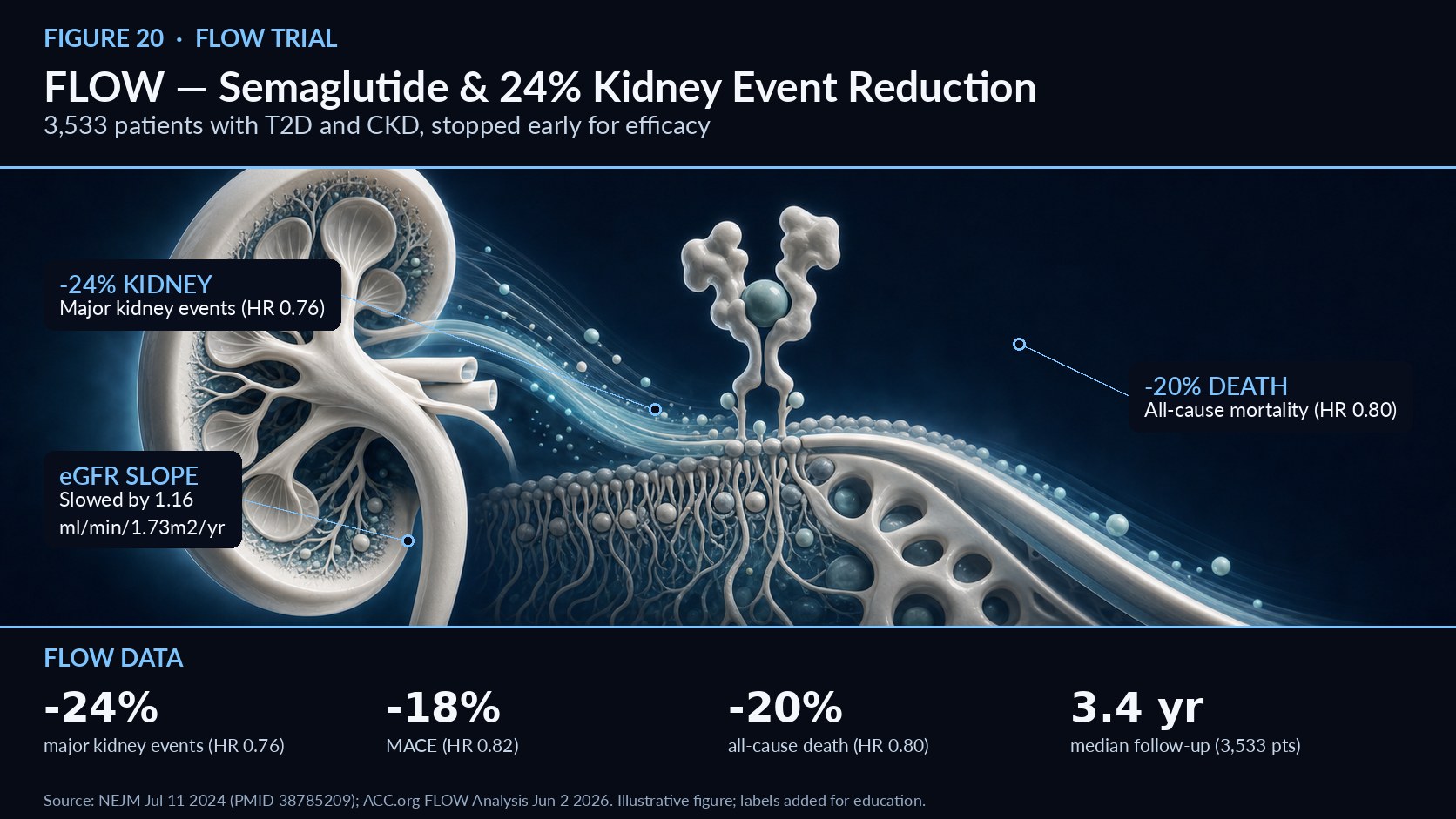

NEWSLETTER 20 FLOW Trial: Semaglutide and 24% Fewer Kidney Events The first dedicated GLP-1 kidney-outcomes trial in type 2 diabetes and CKD   Figure 20. FLOW Trial: Semaglutide and 24% Fewer Kidney Events — mechanism overview (illustrative; labels added for education). FLOW (NCT03819153) was the first large trial designed specifically to test a GLP-1 agonist for kidney outcomes. It randomised 3,533 patients with type 2 diabetes and CKD—1,767 to weekly semaglutide 1.0 mg and 1,766 to placebo—with a median follow-up of 3.4 years, and was stopped early for efficacy; results were published in the New England Journal of Medicine on July 11, 2024.1 The primary result was decisive. The major-kidney-event outcome occurred in 331 versus 410 first events, a 24% relative reduction (HR 0.76, 95% CI 0.66–0.88; P = 0.0003).1 Semaglutide also slowed the mean annual eGFR slope by 1.16 mL/min/1.73 m² (P < 0.001), a clinically meaningful preservation of filtration over time.1 Cardiovascular and mortality benefits accompanied the renal effect: semaglutide reduced MACE by 18% (HR 0.82) and all-cause death by 20% (HR 0.80), with cardiovascular-cause death reduced (HR 0.71, 95% CI 0.56–0.89).1 Serious adverse events were fewer with semaglutide than placebo (49.6% vs 53.8%), reinforcing a favourable benefit-risk profile.1 A June 2026 JACC subgroup analysis confirmed the durability of these findings across cardiovascular phenotypes. The 24% kidney and 20% mortality benefits were consistent with and without ASCVD (HR 0.80 vs 0.74), heart failure (HR 0.67 vs 0.79), and high cardiovascular risk (HR 0.73 in both).2 FLOW’s early termination for efficacy is itself telling: an independent monitoring board judged the kidney benefit so clear that continuing patients on placebo was no longer justified.1 Because it was the first trial powered specifically for kidney outcomes with a GLP-1 agonist, FLOW converted a promising secondary signal into a primary, hard endpoint—slowing eGFR decline and cutting kidney events, cardiovascular death, and all-cause mortality simultaneously, all with fewer serious adverse events than placebo.1 The efficiency of treatment is striking. Numbers needed to treat over three years to prevent one primary kidney outcome were 22 in patients with ASCVD, 13 in those with heart failure, and 17 in the high-risk group.2 These low NNTs, together with the guideline’s recommendation to add GLP-1 therapy for persistent albuminuria, make semaglutide a compelling option for the many CKM patients whose kidneys are already under threat.5 References 1. Effects of Semaglutide on CKD in Type 2 Diabetes (FLOW), NEJM, July 11, 2024 (PMID 38785209). https://pubmed.ncbi.nlm.nih.gov/38785209/ 2. FLOW Analysis: Semaglutide Delivers Consistent Kidney Benefits (JACC subgroup), ACC.org, June 2, 2026. https://www.acc.org/Latest-in-Cardiology/Journal-Scans/2026/06/02/15/27/FLOW-Analysis 3. Evaluate Renal Function With Semaglutide Once Weekly — FLOW, ACC.org Clinical Trials, 2024. https://www.acc.org/latest-in-cardiology/clinical-trials/2024/05/29/17/23/flow 4. Semaglutide Reduced Risk for Major Kidney Disease Events by 24%, ADA Newsroom, June 2024. https://diabetes.org/newsroom/press-releases/semaglutide-reduced-risk-major-kidney-disease-events-24-patients-type-2 5. 2026 CKM Guideline — Top Things to Know, professional.heart.org, June 9, 2026. https://professional.heart.org/en/science-news/2026-guideline-for-the-prevention-detection-evaluation-and-management-of-ckm-syndrome/top-things-to-know 6. Beyond weight loss: multisystem benefits of obesity medications, Lancet Diabetes Endocrinol, May 28, 2026 (PMID 42208956). https://pubmed.ncbi.nlm.nih.gov/42208956/

Downloads

Published

2026-07-07

How to Cite

FLOW Trial: Semaglutide and 24% Fewer Kidney Events The first dedicated GLP-1 kidney-outcomes trial in type 2 diabetes and CKD. (2026). Diabzen, 4(20), 40-41. https://thediabzen.com/index.php/d/article/view/63

Most read articles by the same author(s)

<< < 1 2 3 > >>