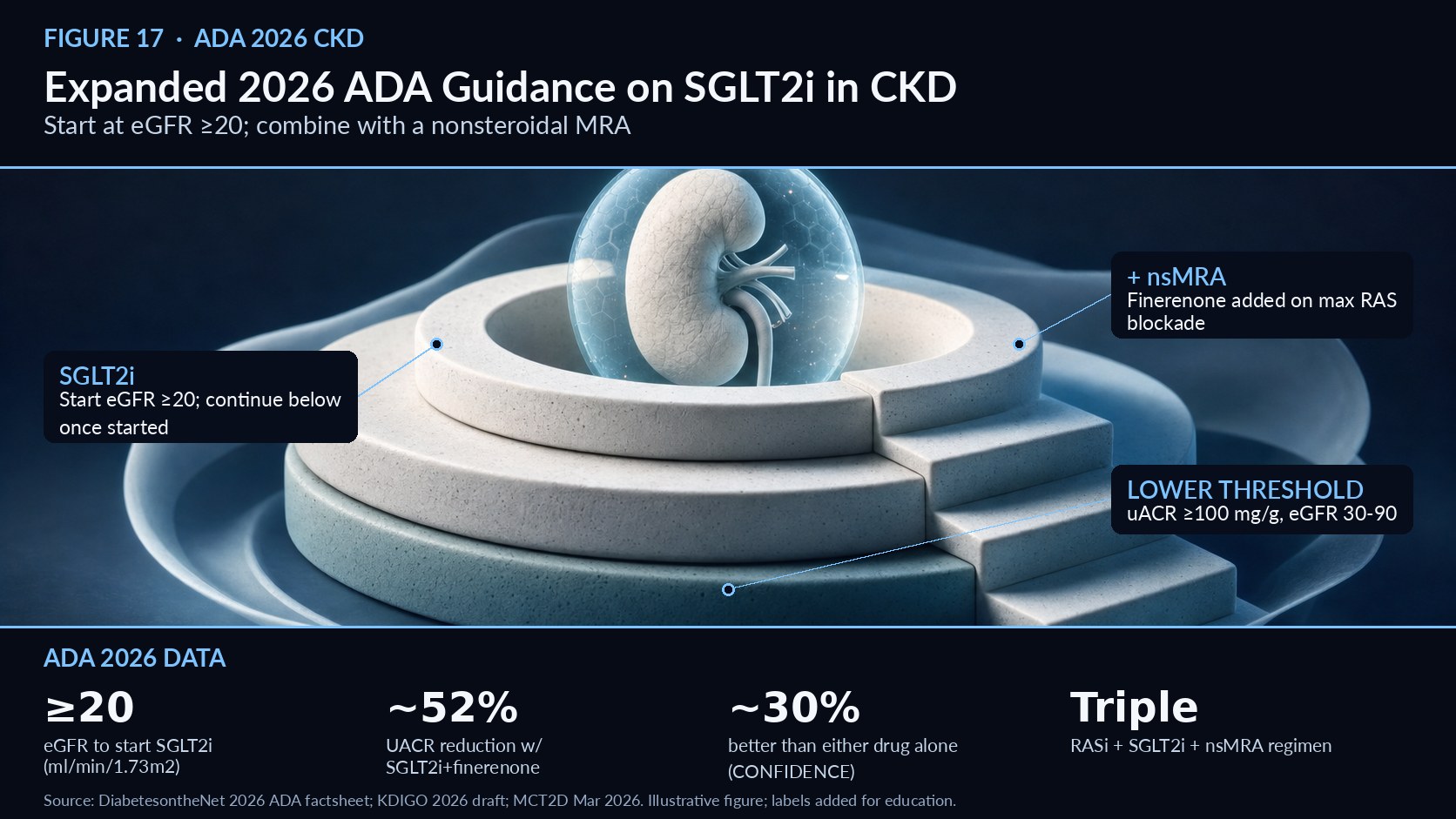

Expanded 2026 ADA Guidance on SGLT2i in CKD Starting at eGFR ≥20 and combining with a nonsteroidal MRA
Keywords:
SGLT2 inhibitors, Finerenone (nonsteroidal MRA), Albuminuria (UACR ≥100 mg/g), eGFR threshold ≥20, CONFIDENCE study, Guideline convergenceAbstract
Abstract
The 2026 ADA Standards of Care sharpen and liberalize recommendations for SGLT2 inhibitor use in chronic kidney disease associated with type 2 diabetes. Key updates permit initiation of SGLT2 inhibitors at an eGFR threshold of ≥20 mL/min/1.73 m² and endorse continuation even if eGFR subsequently falls below that level, recognizing preserved cardiorenal benefits throughout advanced CKD. For adults with type 2 diabetes, UACR ≥100 mg/g, and eGFR 30–90 mL/min/1.73 m² on maximal renin–angiotensin system blockade, clinicians may consider simultaneous initiation of an SGLT2 inhibitor and the nonsteroidal mineralocorticoid receptor antagonist finerenone rather than sequential escalation. This recommendation is driven by quantitative evidence from the CONFIDENCE study, in which the combined regimen produced an approximate 52% reduction in albuminuria—roughly 30% greater than either agent alone—providing a mechanistic surrogate for long‑term renal benefit. The KDIGO 2026 draft and CKM guideline converge on similar thresholds and combination strategies, supporting a unified clinical approach. Practical considerations include baseline and serial monitoring of eGFR and potassium, vigilance for hyperkalaemia when adding MRAs, and patient counselling about adverse effects. While individualized judgment remains essential—especially in frail or polypharmacy patients—the updated guidance favors early, aggressive, evidence‑based renoprotective combination therapy to slow progression in albuminuric CKD.