

Balancing Finerenone Efficacy Against Hyperkalemia Getting organ protection while keeping potassium safe

Authors

  • Dr. Ashutosh Mishra MBBS, MD (Medicine), IMS BHU Fellowship in Diabetes (DFID) CMC Velliore, DMSc, Endocrinology (South Wales), UK english Author

Keywords:

Finerenone, Hyperkalaemia, Potassium monitoring, CKM syndrome, SGLT2 inhibitors, Cardiorenal protection

Abstract

Abstract 
Background: Finerenone provides kidney and cardiovascular protection in chronic kidney disease, but hyperkalaemia remains its principal safety concern. This newsletter summarizes the benefit–risk balance and the monitoring steps that allow safe use across the CKM spectrum.thelancet+2

Methods and safety framework: Evidence from the pooled CKD analysis and the INFINITY programme shows that hyperkalaemia is more frequent with finerenone than placebo, although serious events requiring hospitalisation are uncommon. Trial dosing begins at 10–20 mg once daily and is titrated to 20–40 mg by eGFR, with potassium measured before initiation, after dose changes, and periodically during treatment.pubmed.ncbi.nlm.nih+3

Results: The pooled 14,574-patient analysis confirmed a real hyperkalaemia signal, but routine monitoring and protocol-based dose adjustments limited severe consequences. INFINITY supported a favourable safety profile across diverse CKD populations, reinforcing that the drug can be used broadly when monitoring is in place. Benefits of finerenone were maintained with or without SGLT2-inhibitor co-therapy, and SGLT2 inhibitors may help preserve GFR and reduce hyperkalaemia risk, making them useful partners in patients already on RAAS blockade
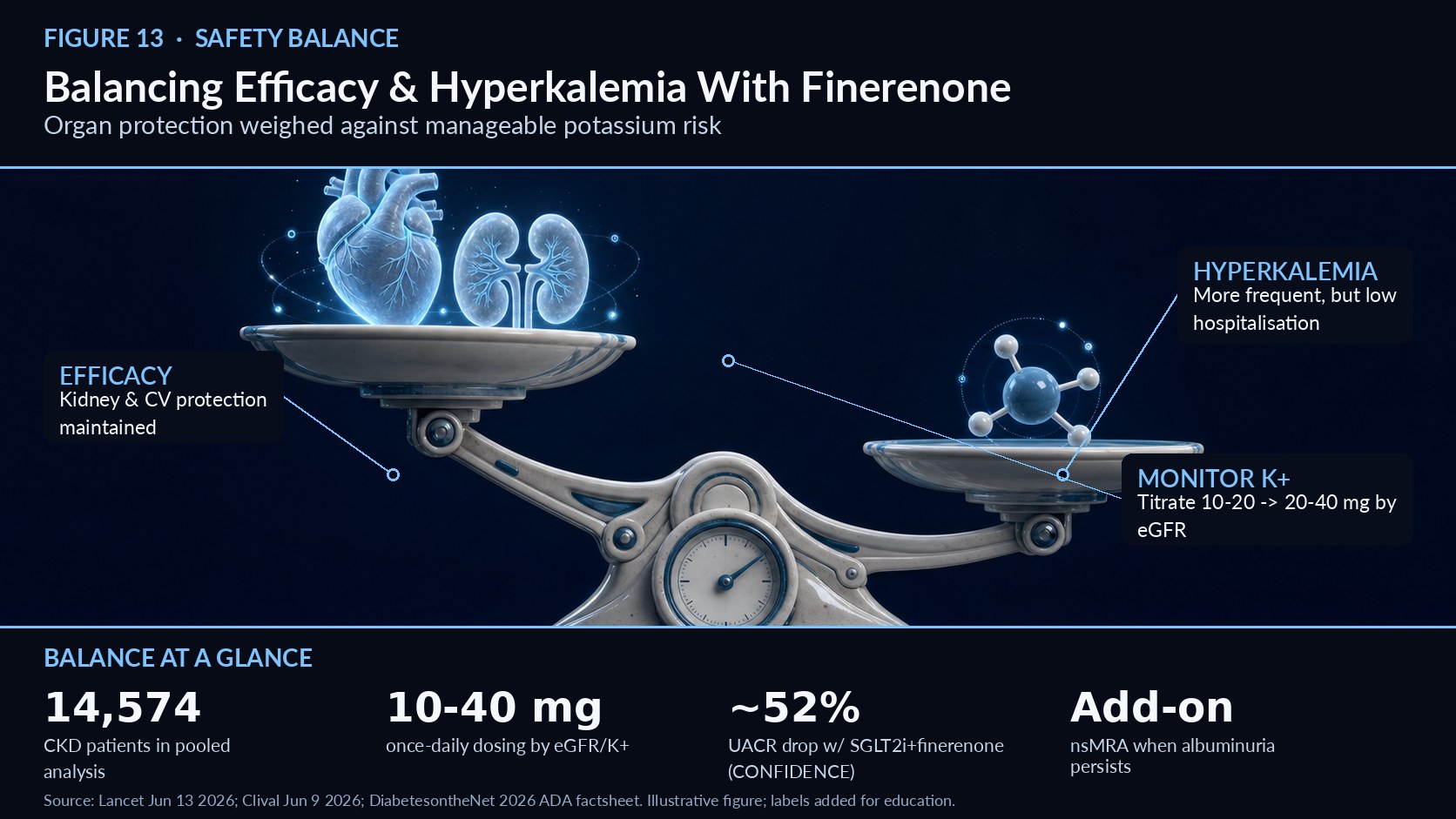

NEWSLETTER 13 Balancing Finerenone Efficacy Against Hyperkalemia Getting organ protection while keeping potassium safe   Figure 13. Balancing Finerenone Efficacy Against Hyperkalemia — mechanism overview (illustrative; labels added for education). Finerenone’s biggest practical challenge is hyperkalaemia, and the 2026 evidence base helps clinicians weigh benefit against this risk. In the pooled analysis of 14,574 CKD patients, hyperkalaemia occurred more frequently with finerenone than placebo, but the absolute incidence of hyperkalaemia leading to hospitalisation was low.1 The signal is real but manageable with monitoring. Structured dosing is the first safeguard. Finerenone starts at 10–20 mg once daily and titrates to 20–40 mg, guided by eGFR and by potassium and protocol-based monitoring.3 Following the trial dosing and surveillance schedule—checking potassium before initiation, after titration, and periodically thereafter—keeps most patients within a safe range. Reassuringly, INFINITY reported that finerenone maintains a favourable safety profile across different CKD patient populations, supporting broader use rather than restriction to narrow subgroups.2 Safety, like efficacy, appears consistent across the spectrum. SGLT2 inhibitors play an unexpectedly helpful role here. Kidney and cardiovascular benefits of finerenone were consistent with or without SGLT2-inhibitor co-therapy, and SGLT2 inhibitors help preserve GFR and limit hyperkalaemia, improving tolerance to RAAS blockade and MRAs.4 Co-prescribing an SGLT2 inhibitor may therefore both add efficacy and buffer potassium. A practical monitoring rhythm makes the risk manageable in routine care: check serum potassium before starting, again after each dose increase, and periodically thereafter, adjusting or pausing therapy if levels rise.3 Because the absolute rate of hyperkalaemia serious enough to require hospitalisation was low in the pooled 14,574-patient analysis, and because INFINITY confirmed a favourable safety profile across CKD populations, the risk should inform vigilance rather than avoidance—particularly when an SGLT2 inhibitor is co-prescribed to buffer potassium.1,2 The guidelines reflect this balance. The 2026 CKM guideline positions the nonsteroidal MRA as add-on therapy when albuminuria persists on RAS inhibitors plus SGLT2 inhibitors—sequencing that lets clinicians establish the potassium-protective foundation before adding finerenone.5 The 2026 ADA Standards go further, supporting simultaneous initiation of an SGLT2 inhibitor and finerenone on maximal RAS blockade, a triple regimen designed to add efficacy while managing potassium risk.6 The take-home message for practice: with eGFR-guided dosing, scheduled potassium checks, and thoughtful pairing with an SGLT2 inhibitor, most CKM patients can safely obtain finerenone’s substantial kidney and cardiovascular protection. References 1. Efficacy and safety of finerenone in CKD (pooled analysis), Lancet, June 13, 2026 (PMID 42248158). https://pubmed.ncbi.nlm.nih.gov/42248158/ 2. Bayer's INFINITY Analysis Shows Finerenone Delivers Long-Term Kidney and Heart Protection, Clival, June 9, 2026. https://clival.com/news/bayers-infinity-analysis-shows-finerenone-delivers-long-term-kidney-and-heart-protection-in-chronic-kidney-disease 3. Finerenone May Cut Sudden Death Risk Across the CKM Spectrum, Medscape, June 16, 2026. https://www.medscape.com/viewarticle/finerenone-may-cut-risk-sudden-death-across-ckm-spectrum-2026a1000kau 4. Mechanisms of Action of SGLT2 Inhibitors, Am J Hypertens, 2024. https://pmc.ncbi.nlm.nih.gov/articles/PMC11471837/ 5. 2026 CKM Guideline — Top Things to Know, professional.heart.org, June 9, 2026. https://professional.heart.org/en/science-news/2026-guideline-for-the-prevention-detection-evaluation-and-management-of-ckm-syndrome/top-things-to-know 6. Factsheet: The 2026 ADA Standards of Care — What's new?, DiabetesontheNet, Dec 2025. https://diabetesonthenet.com/diabetes-primary-care/factsheet-2026-ada-standards/

Downloads

Published

2026-07-07

How to Cite

Balancing Finerenone Efficacy Against Hyperkalemia Getting organ protection while keeping potassium safe. (2026). Diabzen, 4(13), 26-27. https://thediabzen.com/index.php/d/article/view/53

Most read articles by the same author(s)