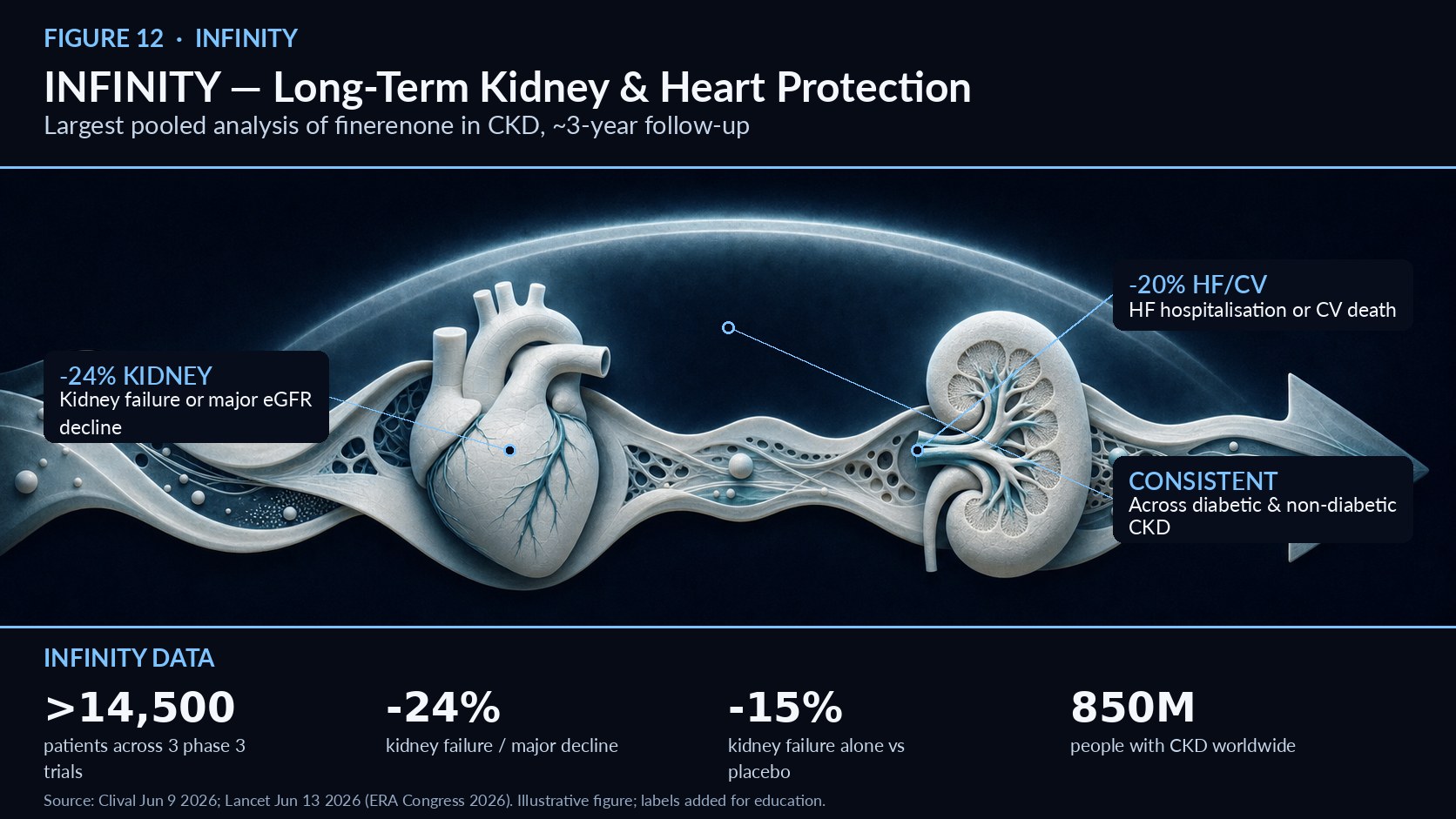

INFINITY: Long-Term Kidney and Heart Protection The largest pooled analysis of finerenone in chronic kidney disease
Keywords:
INFINITY pooled analysis, Finerenone, Chronic kidney disease, Cardiorenal protection, AlbuminuriaAbstract
Abstract
Background: Chronic kidney disease (CKD) drives substantial global morbidity and mortality. INFINITY, the largest pooled analysis of finerenone in CKD, combined participant‑level data from FIDELIO‑DKD, FIGARO‑DKD, and FIND‑CKD to quantify long‑term kidney and cardiovascular benefits.
Methods and population: The pooled dataset included more than 14,500 participants with a median follow‑up of approximately three years. Outcomes evaluated included a composite kidney endpoint (kidney failure or sustained large eGFR decline), kidney failure alone, a composite cardiovascular endpoint (heart‑failure hospitalization or cardiovascular death), all‑cause mortality, and need for dialysis or transplantation. Subgroup analyses assessed consistency across diabetic status, CKD aetiology, baseline eGFR, albuminuria, and SGLT2‑inhibitor use.
Results: Finerenone reduced the risk of the composite kidney outcome by 24% and kidney failure alone by 15% compared with placebo. Cardiovascular protection included a 20% lower risk of heart‑failure hospitalization or cardiovascular death, along with reductions in all‑cause mortality and the need for dialysis or transplantation. Importantly, benefits were consistent across diabetic and non‑diabetic CKD and across baseline kidney function, albuminuria strata, and concurrent SGLT2‑inhibitor therapy.
Conclusions and implications: INFINITY provides robust, generalisable evidence that finerenone confers simultaneous kidney and heart protection in a broad CKD population. These findings support the 2026 guideline endorsement of nonsteroidal MRAs as add‑on therapy for persistent albuminuria and offer clinicians and health systems data to inform treatment selection and resource planning—especially in regions with high CKD prevalence. Would you like this formatted with Harvard in‑text citations or condensed to a single‑paragraph news blurb?