
Top 10 Take-Home Messages of the 2026 CKM Guideline From staging and PREVENT risk to guideline-directed therapy across the spectrum

Authors

  • Dr. Ashutosh Mishra MBBS, MD (Medicine), IMS BHU Fellowship in Diabetes (DFID) CMC Velliore, DMSc, Endocrinology (South Wales), UK English Author

Keywords:

CKM guideline, cardiovascular–kidney–metabolic syndrome, PREVENT risk, CKD staging, SGLT2 inhibitors, GLP‑1 receptor agonists, nonsteroidal MRA, obesity pharmacotherapy, interdisciplinary care, implementation, ASCVD, heart failure

Abstract

Abstract
Background: The 2026 Cardiovascular–Kidney–Metabolic (CKM) Guideline introduces an integrated approach to prevent, detect, evaluate, and manage overlapping cardiometabolic, renal, and metabolic conditions. Its companion "Top Things to Know" distils the guideline into ten clinically actionable messages.

Objective: To summarise the guideline’s top 10 messages and map them onto a pragmatic clinical workflow—stage, predict, assess, coordinate, and treat—facilitating rapid translation into practice.

Methods: We synthesise the companion guidance, emphasising CKM staging for youths and adults, application of PREVENT equations for 10‑ and 30‑year risk estimation in Stages 0–3, systematic assessment of metabolic and kidney parameters (including eGFR and UACR), targeted screening for pre‑heart failure, MASLD, and OSA, routine evaluation of social determinants of health, and the role of an interdisciplinary CKM coordination point person. We summarise pharmacotherapy recommendations: cardioprotective antihyperglycaemic agents (SGLT2 inhibitors, GLP‑1 receptor agonists), renin–angiotensin system inhibitors plus SGLT2 inhibitors as first‑line for CKD with albuminuria, and addition of nonsteroidal MRAs or GLP‑1 therapy when albuminuria persists. Guidance for ASCVD and heart‑failure phenotypes is also outlined.

Results/Conclusions: The ten messages function as an implementation blueprint that supports creation of order sets, dashboards, and quality metrics. They enable clinicians and health systems to operationalise evidence‑based, organ‑protective care across CKM stages and comorbidities, thereby closing implementation gaps and improving patient outcomes.
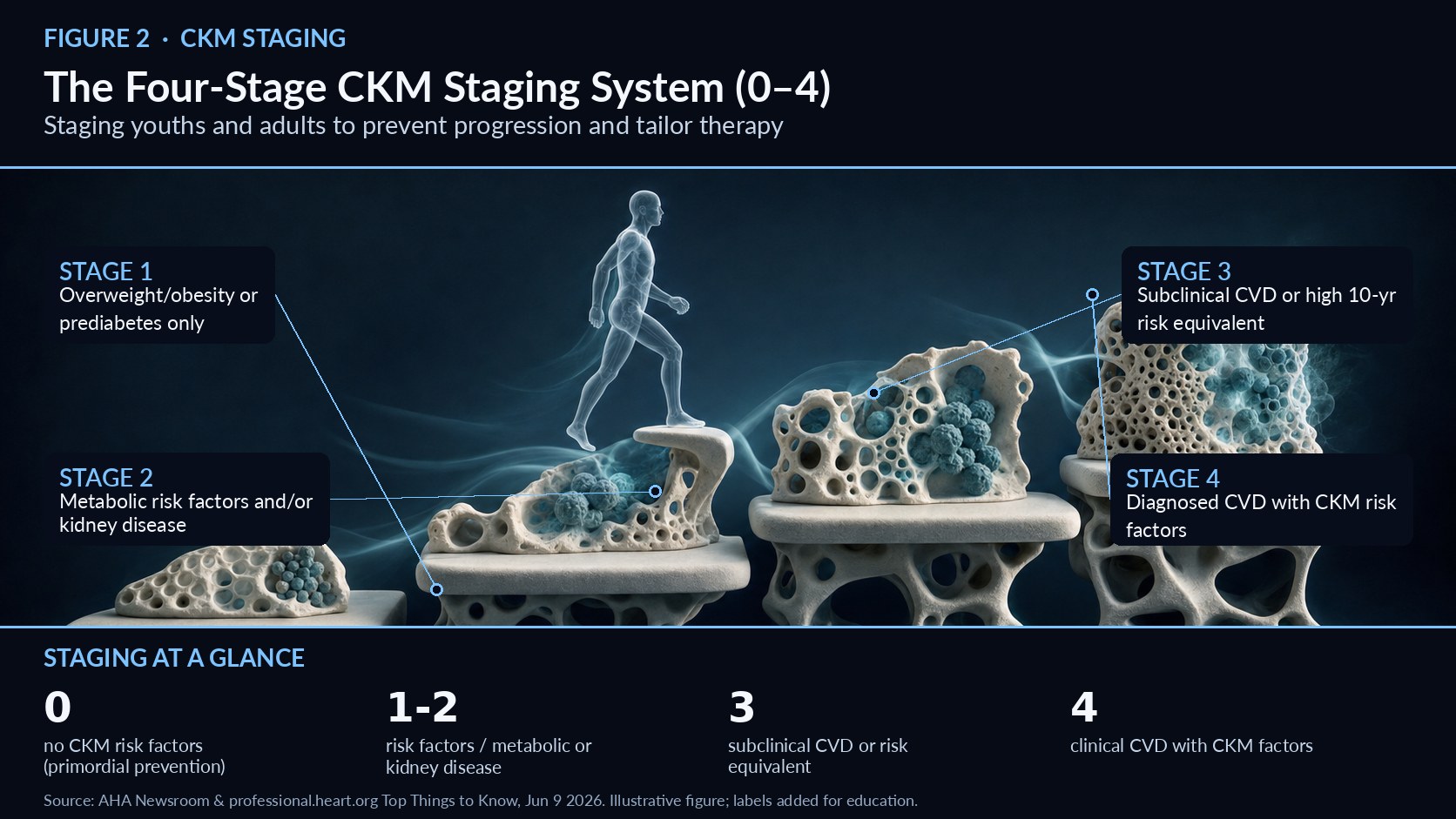
NEWSLETTER 3 Top 10 Take-Home Messages of the 2026 CKM Guideline From staging and PREVENT risk to guideline-directed therapy across the spectrum   Figure 3. Top 10 Take-Home Messages of the 2026 CKM Guideline — mechanism overview (illustrative; labels added for education). The guideline’s companion “Top Things to Know” distils the document into ten clinically actionable messages that map neatly onto a workflow of stage, predict, assess, coordinate, and treat.1 <b>Messages 1–2</b> establish the foundation: CKM staging is recommended for youths and adults, and in Stages 0–3 risk should be quantified using the PREVENT equations, which estimate 10- and 30-year risk for atherosclerotic cardiovascular disease, heart failure, and total cardiovascular disease.1 <b>Messages 3–5</b> address systematic evaluation: routinely assess metabolic risk factors and kidney function—with selected assessment for pre-heart-failure, MASLD, and obstructive sleep apnoea—screen and address social determinants of health, and deliver interdisciplinary care anchored by a CKM coordination point person.1 <b>Message 6</b> reframes adiposity: assess overweight/obesity and abdominal adiposity using both BMI and waist circumference, and support lifestyle modification with adjunctive obesity pharmacotherapy and metabolic/bariatric surgery when indicated.1 <b>Messages 7–8</b> define pharmacotherapy: in type 2 diabetes with or at risk for cardiovascular disease, use cardioprotective antihyperglycaemic therapy (SGLT2 inhibitors, GLP-1-based therapy, or both); use both eGFR and UACR to characterise CKD, with RAS inhibitors plus SGLT2 inhibitors first-line and a nonsteroidal MRA or GLP-1 therapy added if albuminuria persists.1 Taken together, the ten messages function as an implementation blueprint rather than a list of ideals. They move in a logical sequence—stage the patient, predict risk with PREVENT, assess metabolic and kidney parameters plus social needs, coordinate an interdisciplinary team, and then treat with organ-protective agents matched to comorbidities.1 Because each message maps to a concrete clinical action, a hospital can convert them almost directly into order sets, dashboards, and quality metrics—exactly the kind of structured workflow that closes the gap between guideline publication and bedside practice.2 <b>Messages 9–10</b> extend care into established disease: in ASCVD, emphasise CKM comorbidities including obesity treatment and kidney-protective agents; in HFrEF use RAS inhibitor/ARNI plus SGLT2 inhibitor within quadruple therapy, and in HFmrEF/HFpEF use SGLT2 inhibitors first-line, add GLP-1 therapy for obesity, and consider nonsteroidal MRAs in patients with type 2 diabetes and CKD.1 Together the messages give clinicians and administrators a concise checklist for auditing whether CKM patients are receiving the full spectrum of evidence-based, organ-protective care.2,3 References 1. 2026 CKM Guideline — Top Things to Know, professional.heart.org, June 9, 2026. https://professional.heart.org/en/science-news/2026-guideline-for-the-prevention-detection-evaluation-and-management-of-ckm-syndrome/top-things-to-know 2. First-Ever Guideline Addresses CKM Syndrome, ACC.org Journal Scan, June 9, 2026. https://www.acc.org/latest-in-cardiology/journal-scans/2026/06/08/17/44/first-ever-guideline-addresses-ckm-syndrome 3. First-ever guideline on CKM syndrome issued, AHA Newsroom, June 9, 2026. https://newsroom.heart.org/news/first-ever-guideline-on-cardiovascular-kidney-metabolic-syndrome-issued 4. New guideline reframes weight as health risk, AHA Newsroom, June 9, 2026. https://newsroom.heart.org/news/new-guideline-reframes-weight-as-health-risk-tied-to-diabetes-kidney-and-heart-conditions 5. A new guideline links care for heart, kidney and metabolic diseases, Science News, June 10, 2026. https://www.sciencenews.org/article/heart-diabetes-kidney-disease-treatment 6. The Role of GLP-1 Receptor Agonists in the Treatment of CKM Syndrome, JACC Adv, Jan 2026 (PMID 41609289). https://pubmed.ncbi.nlm.nih.gov/41609289/

Downloads

Published

2026-07-07

How to Cite

Top 10 Take-Home Messages of the 2026 CKM Guideline From staging and PREVENT risk to guideline-directed therapy across the spectrum. (2026). Diabzen, 4(3), 6-7. https://thediabzen.com/index.php/d/article/view/42

Most read articles by the same author(s)

<< < 1 2 3