

Stratifying Cardiovascular–Kidney–Metabolic Syndrome by Metabolic Dysfunction-Associated Steatotic Liver Disease: A Pathophysiology-Anchored, India-Contextualised Framework for Node-Directed Pharmacotherapy

Authors

  • Dr. Ashutosh Mishra MBBS, MD (Medicine), IMS BHU Fellowship in Diabetes (DFID) CMC Velliore, DMSc, Endocrinology (South Wales), UK Consultant Endocrinologist & Diabetologist Editor-in-Chief — CKM Integration, Clinical Protocols, Varanasi Declaration English Author

Keywords:

cardiovascular–kidney–metabolic syndrome, MASLD, MASH, liver fibrosis, resmetirom, GLP-1 receptor agonist, finerenone, saroglitazar, lean NAFLD

Abstract

Abstract

The same drug can protect the heart, the kidney and the liver at once—not by coincidence, but because these organs share a small set of molecular failure points. Cardiovascular–kidney–metabolic (CKM) syndrome, formalised by the American Heart Association in 20231,2 and codified in the first-ever 2026 AHA/ACC/ADA/ASN multisociety guideline3, describes the progression from dysfunctional adiposity through cardiorenal and metabolic injury. Its staging construct, however, incorporates the liver only implicitly, despite metabolic dysfunction-associated steatotic liver disease (MASLD)4 being both a near-universal companion of CKM and an independent, pharmacologically actionable amplifier of its trajectory. This review advances a pathophysiology-anchored framework positioning MASLD as the hepatic node of CKM and liver fibrosis stage as a quantitative modifier that reclassifies cardiorenal-metabolic risk. We first deconstruct the shared molecular nodes linking liver, heart, kidney and adipose tissue—adipose lipotoxicity, hepatic de novo lipogenesis and the thyroid/ATP-citrate lyase axis, stellate-cell fibrosis, NLRP3-inflammasome inflammation, the mineralocorticoid–fibrotic axis, the cardiorenal hemodynamic–tubular axis, and the gut–liver axis. We then map the contemporary pharmacopoeia—incretin and multi-agonists, sodium–glucose cotransporter-2 (SGLT2) inhibitors, pioglitazone, the thyroid hormone receptor-β agonist resmetirom, fibroblast growth factor 21 (FGF21) analogues, the nonsteroidal mineralocorticoid antagonist finerenone, bempedoic acid, low-dose colchicine, and microbiome-directed strategies—onto these nodes rather than onto organ silos; two agents (resmetirom36 and semaglutide24) now carry regulatory approval for steatohepatitis with fibrosis. Because the epidemiology, phenotype, genetics, diet and drug-access realities of South Asia materially alter how the framework applies, we integrate an India-specific analysis throughout59,62. Synthesising the evidence into a CKM-stage × fibrosis-stage selection matrix (rendered as an India-adapted therapeutic ladder) and a tiered evidence appraisal, we argue that fibrosis stage, not organ label, should guide individualised pharmacotherapy across the CKM spectrum
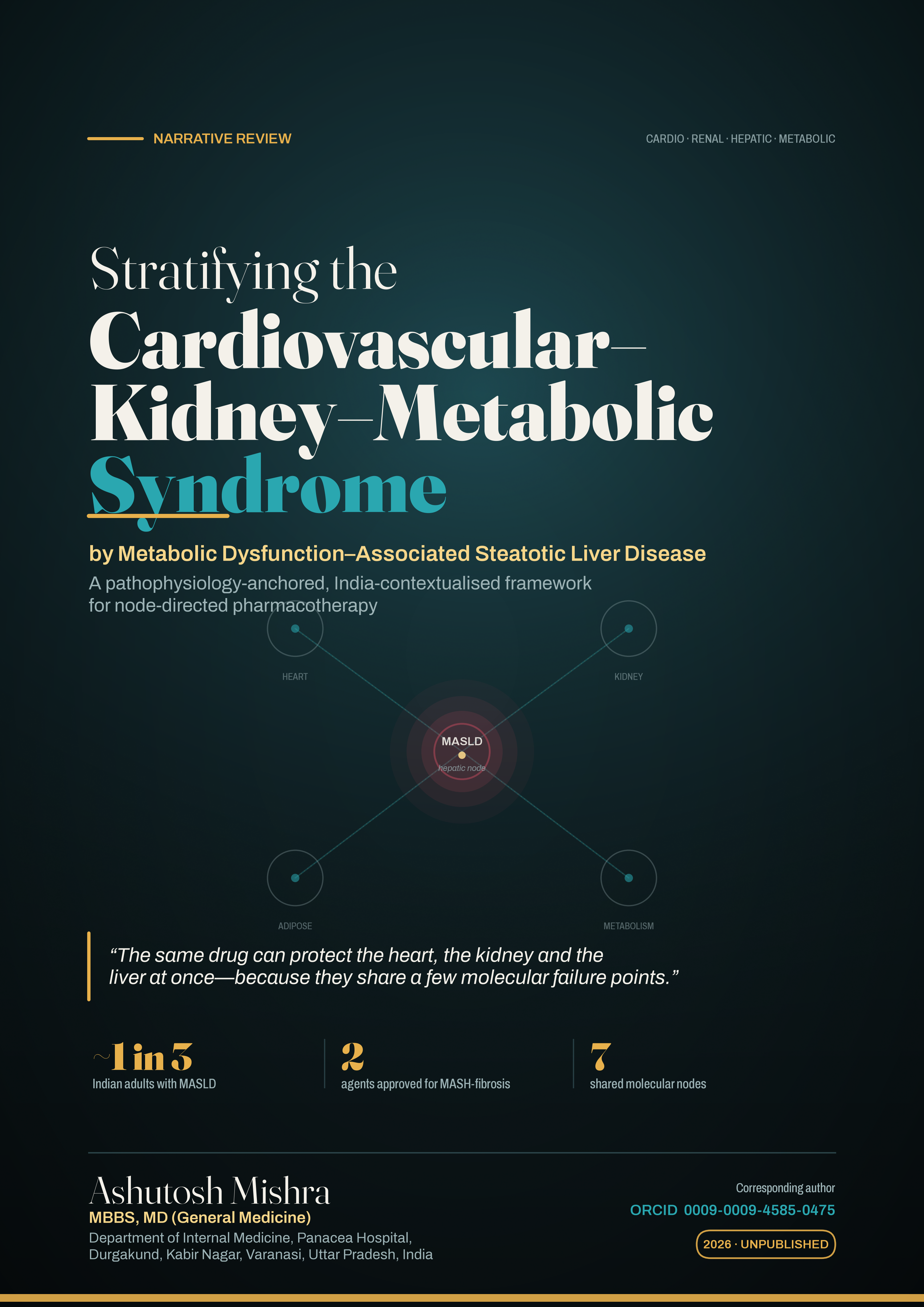

Stratifying Cardiovascular–Kidney–Metabolic Syndrome by Metabolic Dysfunction-Associated Steatotic Liver Disease: A Pathophysiology-Anchored, India-Contextualised Framework for Node-Directed Pharmacotherapy Ashutosh Mishra, MBBS, MD (General Medicine)¹ ¹ Department of Internal Medicine, Panacea Hospital, Durgakund, Kabir Nagar, Varanasi, Uttar Pradesh, India Corresponding author: Ashutosh Mishra. ORCID: 0009-0009-4585-0475. Article type: Narrative Review  Abstract The same drug can protect the heart, the kidney and the liver at once—not by coincidence, but because these organs share a small set of molecular failure points. Cardiovascular–kidney–metabolic (CKM) syndrome, formalised by the American Heart Association in 20231,2 and codified in the first-ever 2026 AHA/ACC/ADA/ASN multisociety guideline3, describes the progression from dysfunctional adiposity through cardiorenal and metabolic injury. Its staging construct, however, incorporates the liver only implicitly, despite metabolic dysfunction-associated steatotic liver disease (MASLD)4 being both a near-universal companion of CKM and an independent, pharmacologically actionable amplifier of its trajectory. This review advances a pathophysiology-anchored framework positioning MASLD as the hepatic node of CKM and liver fibrosis stage as a quantitative modifier that reclassifies cardiorenal-metabolic risk. We first deconstruct the shared molecular nodes linking liver, heart, kidney and adipose tissue—adipose lipotoxicity, hepatic de novo lipogenesis and the thyroid/ATP-citrate lyase axis, stellate-cell fibrosis, NLRP3-inflammasome inflammation, the mineralocorticoid–fibrotic axis, the cardiorenal hemodynamic–tubular axis, and the gut–liver axis. We then map the contemporary pharmacopoeia—incretin and multi-agonists, sodium–glucose cotransporter-2 (SGLT2) inhibitors, pioglitazone, the thyroid hormone receptor-β agonist resmetirom, fibroblast growth factor 21 (FGF21) analogues, the nonsteroidal mineralocorticoid antagonist finerenone, bempedoic acid, low-dose colchicine, and microbiome-directed strategies—onto these nodes rather than onto organ silos; two agents (resmetirom36 and semaglutide24) now carry regulatory approval for steatohepatitis with fibrosis. Because the epidemiology, phenotype, genetics, diet and drug-access realities of South Asia materially alter how the framework applies, we integrate an India-specific analysis throughout59,62. Synthesising the evidence into a CKM-stage × fibrosis-stage selection matrix (rendered as an India-adapted therapeutic ladder) and a tiered evidence appraisal, we argue that fibrosis stage, not organ label, should guide individualised pharmacotherapy across the CKM spectrum. Keywords: cardiovascular–kidney–metabolic syndrome; MASLD; MASH; liver fibrosis; resmetirom; GLP-1 receptor agonist; FGF21; finerenone; SGLT2 inhibitor; India; lean NAFLD; saroglitazar Abbreviations ACC, acetyl-CoA carboxylase; ACLY, ATP-citrate lyase; AHA, American Heart Association; AMPK, AMP-activated protein kinase; ASCVD, atherosclerotic cardiovascular disease; ChREBP, carbohydrate-response element-binding protein; CKD, chronic kidney disease; CKM, cardiovascular–kidney–metabolic; CKLM, cardiovascular–kidney–liver–metabolic; DAG, diacylglycerol; DCGI, Drugs Controller General of India; DNL, de novo lipogenesis; FASN, fatty-acid synthase; FGF19/21, fibroblast growth factor 19/21; FXR, farnesoid X receptor; GIP, glucose-dependent insulinotropic polypeptide; GLP-1 RA, glucagon-like peptide-1 receptor agonist; HFpEF, heart failure with preserved ejection fraction; HSC, hepatic stellate cell; IL, interleukin; INASL, Indian National Association for Study of the Liver; IRS-1, insulin-receptor substrate-1; LPS, lipopolysaccharide; MASLD, metabolic dysfunction-associated steatotic liver disease; MASH, metabolic dysfunction-associated steatohepatitis; MR(A), mineralocorticoid receptor (antagonist); NLRP3, NLR family pyrin domain containing 3; PKCε, protein kinase C-epsilon; PNPLA3, patatin-like phospholipase domain-containing 3; PPAR, peroxisome proliferator-activated receptor; RSSDI, Research Society for the Study of Diabetes in India; SCFA, short-chain fatty acid; SGLT2, sodium–glucose cotransporter-2; SREBP-1c, sterol regulatory element-binding protein 1c; T2D, type 2 diabetes; TGF-β, transforming growth factor beta; THR-β, thyroid hormone receptor beta; TM6SF2, transmembrane 6 superfamily member 2; TMAO, trimethylamine-N-oxide. 1. Introduction The 2023 American Heart Association Presidential Advisory on cardiovascular–kidney–metabolic (CKM) health reframed a cluster of previously siloed conditions—obesity, type 2 diabetes (T2D), chronic kidney disease (CKD), and the atherosclerotic and heart-failure phenotypes of cardiovascular disease—as a single, staged continuum driven by shared upstream biology1. The construct assigns individuals to stages 0 through 4, from the absence of risk factors, through excess or dysfunctional adiposity and metabolic risk factors, to subclinical and then clinical cardiovascular–renal disease2. In June 2026 the first-ever AHA/ACC/ADA/ASN multisociety guideline operationalised this staging for practice, embedding routine cardiorenal-metabolic risk assessment and prioritising cardioprotective antihyperglycaemic therapy3. Conspicuously, the liver occupies an ambiguous place in this schema. MASLD—renamed from non-alcoholic fatty liver disease in the 2023 multisociety Delphi nomenclature statement to foreground its metabolic aetiology4—appears in CKM guidance chiefly as a screening consideration rather than as a staging axis, even though it shares every upstream driver of the syndrome and affects an estimated quarter to a third of the global adult population. This omission is increasingly untenable. Advancing MASLD, and specifically the transition from simple steatosis through metabolic dysfunction-associated steatohepatitis (MASH) to fibrosis, independently predicts incident heart failure (particularly the preserved-ejection-fraction phenotype), CKD progression, and atherosclerotic events over and above conventional risk factors. A 2026 roadmap in the Journal of the American College of Cardiology went so far as to argue for expanding the construct to a cardiovascular–kidney–liver–metabolic (CKLM) syndrome and redesigning trials around multiorgan endpoints5. The clinical consequence of leaving the liver implicit is that pharmacotherapy is selected by organ label—a cardiologist’s, nephrologist’s, or hepatologist’s remit—rather than by the shared mechanism a given drug actually engages. Yet the therapeutic landscape has shifted decisively: within twenty-four months, two agents earned regulatory approval for MASH with fibrosis36,24, an entire class of direct antifibrotics entered phase 3, and several cardiorenal-outcome drugs were shown to act on nodes common to liver, heart, and kidney. This review therefore proposes a deliberately simple reorganisation. We treat MASLD as the hepatic node superimposed on the four-organ CKM construct, and liver fibrosis stage (F0–F4) as a quantitative modifier that reclassifies cardiorenal-metabolic risk and should inform drug choice. We then map the contemporary pharmacopoeia onto the pathophysiological nodes these drugs share, contextualise the framework for the Indian population in which the author practises, and translate the result into a stage-by-fibrosis selection matrix. Our thesis is that fibrosis stage, not organ label, is the axis along which CKM pharmacotherapy should be individualised.

Downloads

Published

2026-07-07

How to Cite

Stratifying Cardiovascular–Kidney–Metabolic Syndrome by Metabolic Dysfunction-Associated Steatotic Liver Disease: A Pathophysiology-Anchored, India-Contextualised Framework for Node-Directed Pharmacotherapy. (2026). Diabzen, 5(1), 1-23. https://thediabzen.com/index.php/d/article/view/40