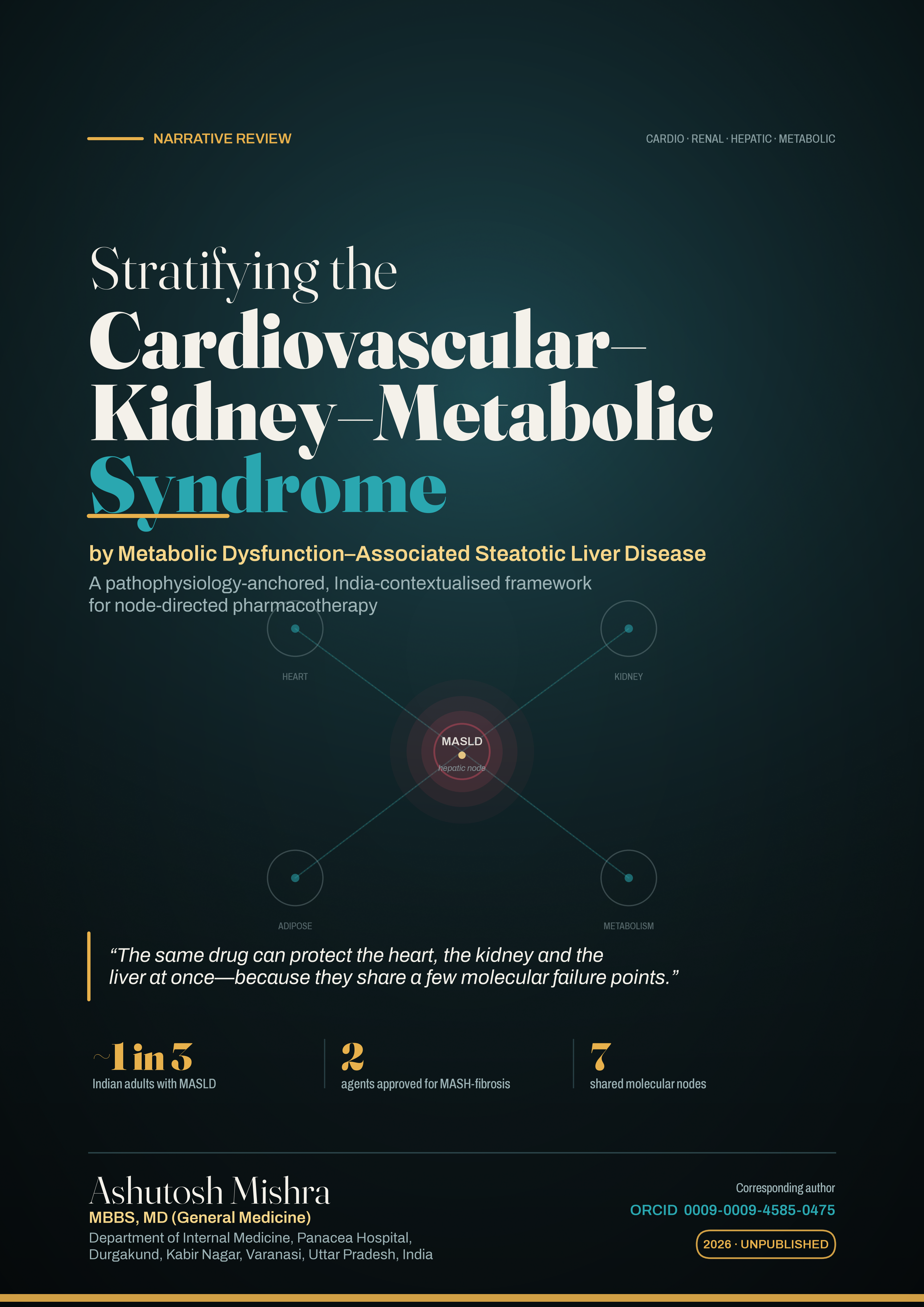

Stratifying Cardiovascular–Kidney–Metabolic Syndrome by Metabolic Dysfunction-Associated Steatotic Liver Disease: A Pathophysiology-Anchored, India-Contextualized Framework for Node-Directed Pharmacotherapy
Keywords:
cardiovascular–kidney–metabolic syndrome, MASLD, MASH, liver fibrosis, resmetirom, GLP-1 receptor agonist, FGF21, finerenone, SGLT2 inhibitor, India, lean NAFLD, saroglitazarAbstract
AbstractThe same drug can protect the heart, the kidney and the liver at once—not by coincidence, but because these organs share a small set of molecular failure points. Cardiovascular–kidney–metabolic (CKM) syndrome, formalized by the American Heart Association in 20231,2 and codified in the first-ever 2026 AHA/ACC/ADA/ASN multisociety guideline3, describes the progression from dysfunctional adiposity through cardiorenal and metabolic injury. Its staging construct, however, incorporates the liver only implicitly, despite metabolic dysfunction-associated steatotic liver disease (MASLD)4 being both a near-universal companion of CKM and an independent, pharmacologically actionable amplifier of its trajectory. This review advances a pathophysiology-anchored framework positioning MASLD as the hepatic node of CKM and liver fibrosis stage as a quantitative modifier that reclassifies cardiorenal-metabolic risk. We first deconstruct the shared molecular nodes linking liver, heart, kidney and adipose tissue—adipose lipotoxicity, hepatic de novo lipogenesis and the thyroid/ATP-citrate lyase axis, stellate-cell fibrosis, NLRP3-inflammasome inflammation, the mineralocorticoid–fibrotic axis, the cardiorenal hemodynamic–tubular axis, and the gut–liver axis. We then map the contemporary pharmacopoeia—incretin and multi-agonists, sodium–glucose cotransporter-2 (SGLT2) inhibitors, pioglitazone, the thyroid hormone receptor-β agonist resmetirom, fibroblast growth factor 21 (FGF21) analogues, the nonsteroidal mineralocorticoid antagonist finerenone, bempedoic acid, low-dose colchicine, and microbiome-directed strategies—onto these nodes rather than onto organ silos; two agents (resmetirom36 and semaglutide24) now carry regulatory approval for steatohepatitis with fibrosis. Because the epidemiology, phenotype, genetics, diet and drug-access realities of South Asia materially alter how the framework applies, we integrate an India-specific analysis throughout59,62. Synthesising the evidence into a CKM-stage × fibrosis-stage selection matrix (rendered as an India-adapted therapeutic ladder) and a tiered evidence appraisal, we argue that fibrosis stage, not organ label, should guide individualised pharmacotherapy across the CKM spectrum.