

Vol. 4 No. 15 (2026): SGLT2 Inhibitors in Elderly and Frail CKM Patients Consistent benefit across age and frailty, with no excess hypoglycaemia
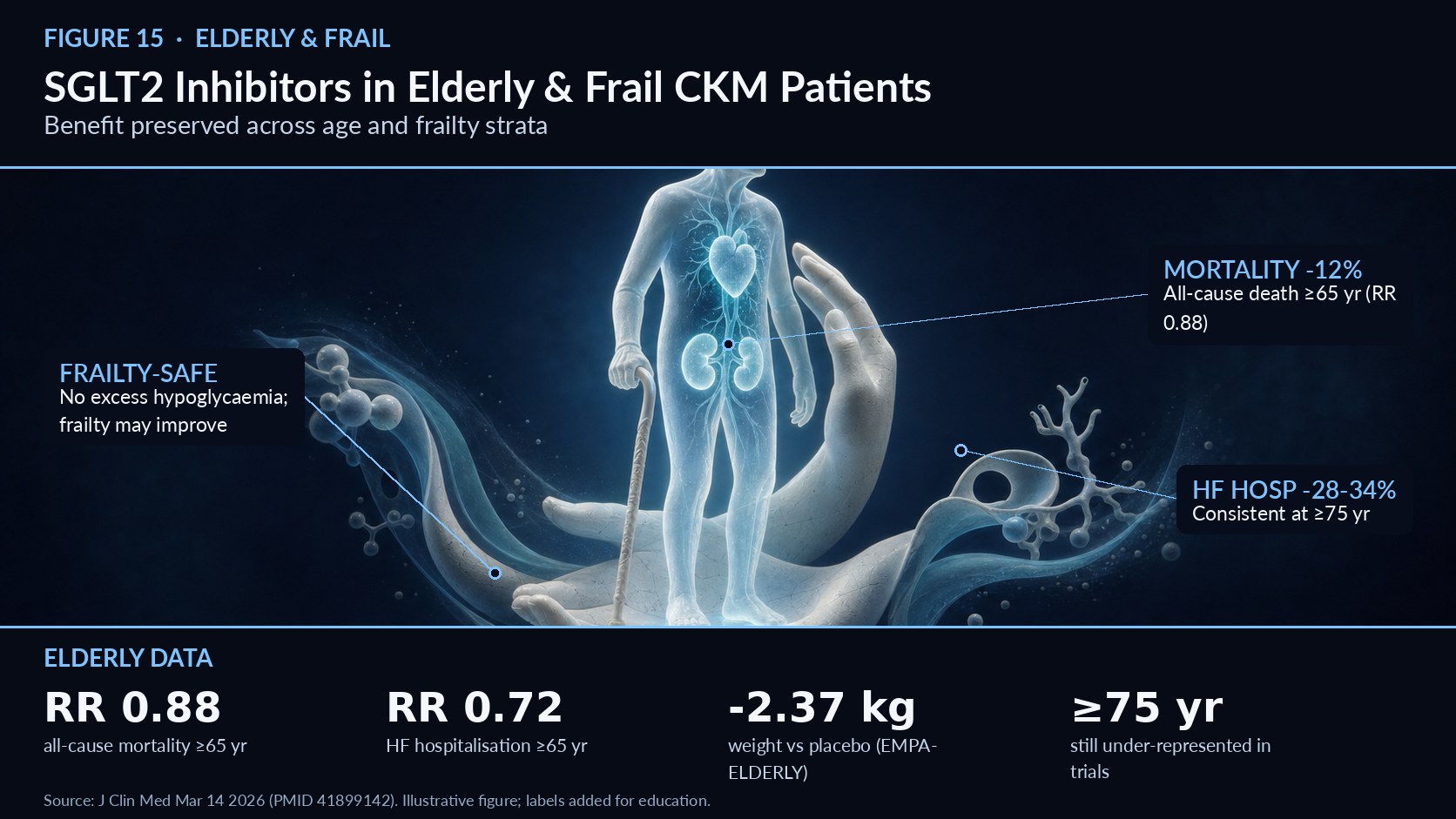
SGLT2 Inhibitors in Elderly and Frail CKM Patients Consistent benefit across age and frailty, with no excess hypoglycaemia   Figure 15. SGLT2 Inhibitors in Elderly and Frail CKM Patients — mechanism overview (illustrative; labels added for education). Clinicians often hesitate to prescribe SGLT2 inhibitors in older, frail patients, but a 2026 review in the Journal of Clinical Medicine provides reassurance. In patients aged 65 and older, SGLT2 inhibitors reduced all-cause mortality (RR 0.88, 95% CI 0.83–0.95), cardiovascular death, heart-failure hospitalisation (RR 0.72), and major adverse cardiovascular events (RR 0.87).1 The heart-failure benefit was robust with advancing age: hospitalisation reductions ranged 28–34% in those 65 and older, with similar benefit at 75 and above.1 Strikingly, the MACE benefit was greater in older versus younger patients (HR 0.76, 95% CI 0.62–0.93 per 30-year increase in age), suggesting that older patients may derive more, not less, absolute protection.1 Safety concerns were not borne out. SGLT2 inhibitors did not increase hypoglycaemia risk in older adults, and they reduced albuminuria (RR 0.71) and acute kidney injury (RR 0.70).1 Given how much clinical inertia stems from fear of hypoglycaemia and renal harm, these data directly counter the main objections. Frailty did not blunt efficacy. Benefits were consistent across frailty strata in DAPA-HF, DELIVER, EMPEROR-Preserved, and CANVAS/CREDENCE, and empagliflozin was associated with improvement in frailty status over follow-up—a notable finding in a population where functional decline dominates outcomes.1 The practical implication is a reversal of the usual caution: rather than a reason to withhold therapy, older age may strengthen the case for it, given the larger absolute event reduction and preserved safety.1 Clinicians should still individualise—monitoring volume status, adjusting diuretics, and attending to nutrition and muscle mass given the small lean-mass signal in EMPA-ELDERLY—but frailty per se did not diminish efficacy across the major trials, and empagliflozin was even associated with improved frailty status over follow-up.1 Body composition warrants attention. EMPA-ELDERLY showed a placebo-adjusted body-weight reduction of −2.37 kg (95% CI −3.07 to −1.68; P < 0.001), with non-significant trends toward reduced muscle and lean mass in elderly patients—arguing for attention to nutrition and resistance activity.1 Importantly, the review notes that adults 75 and older remain underrepresented in trials, and no RCTs are specifically designed for frail or nursing-home populations, so individualised judgement still matters.1 On balance, age and frailty are not reasons to withhold this therapy. References 1. Evidence on SGLT2 Inhibitors' Efficacy in Older and Frail Patients, J Clin Med, March 14, 2026 (PMID 41899142). https://pmc.ncbi.nlm.nih.gov/articles/PMC13027104/ 2. Beyond Glucose Control: A Comprehensive Review of SGLT2 Inhibitors, Cureus, March 2, 2026. https://pmc.ncbi.nlm.nih.gov/articles/PMC12952939/ 3. Mechanisms of Action of SGLT2 Inhibitors, Am J Hypertens, 2024. https://pmc.ncbi.nlm.nih.gov/articles/PMC11471837/ 4. 2026 CKM Guideline — Top Things to Know, professional.heart.org, June 9, 2026. https://professional.heart.org/en/science-news/2026-guideline-for-the-prevention-detection-evaluation-and-management-of-ckm-syndrome/top-things-to-know 5. KDIGO 2026 Diabetes and CKD Guideline Update Public Review Draft, March 2026. https://kdigo.org/wp-content/uploads/2026/03/KDIGO-2026-Diabetes-and-CKD-Guideline-Update-Public-Review-Draft-March-2026.pdf 6. Factsheet: The 2026 ADA Standards of Care — What's new?, DiabetesontheNet, Dec 2025. https://diabetesonthenet.com/diabetes-primary-care/factsheet-2026-ada-standards/

Description:
SGLT2 inhibitors remain effective and safe in older and frail CKM patients, challenging the common reluctance to prescribe them in these groups. In adults aged 65 years and older, they reduce all-cause mortality, cardiovascular death, heart-failure hospitalization, and major adverse cardiovascular events, with benefits persisting at age 75 and beyond. Importantly, the relative benefit does not diminish with age, and absolute risk reduction may be greater because baseline event rates are higher. Safety data are reassuring: there is no increase in hypoglycaemia, while albuminuria and acute kidney injury are reduced. Frailty does not blunt efficacy across major trials, and empagliflozin has even been associated with improvement in frailty status over follow-up. Although body composition changes and volume status still require attention, the overall balance favors treatment rather than avoidance. The practical message is clear: older age and frailty should prompt careful monitoring and individualized prescribing, not automatic withholding of a therapy that provides meaningful cardiorenal protection.


Published: 2026-07-07