
SGLT2 Inhibitor Safety Signals in FAERS Ketoacidosis and other adverse events across 154,476 spontaneous reports

Authors

  • Dr Ashutosh Mishra English Author

Keywords:

FAERS dataset, SGLT2 inhibitors, Ketoacidosis/DKA, Euglycaemic DKA, Volume depletion/AKI, Genital mycotic infection, Lower‑limb amputation, Fournier’s gangrene, Reporting bias

Abstract

Abstract
A June 2026 FAERS extract of 154,476 reports highlights real‑world safety signals for SGLT2 inhibitors (2013–early 2026). Serious outcomes were frequently reported (66.1% serious; 8.6% fatal), reflecting reporting bias toward severe events. Diabetic ketoacidosis was the dominant signal: 15,288 ketoacidosis reports including 3,108 euglycaemic DKA cases—an important clinical hazard because normal glucose can mask the diagnosis. Other notable signals included volume depletion/AKI (9,162), genital mycotic infections (5,385), lower‑limb amputation (4,819), and rare Fournier’s gangrene (630). Prior disproportionality analyses show markedly higher acidosis reporting versus DPP‑4 inhibitors, reinforcing vigilance. FAERS counts are not incidence estimates, so findings should guide risk‑mitigation rather than abandonment of therapy. Clinically, implement structured patient education, sick‑day rules, perioperative holds, and low threshold for ketone testing in unwell patients on SGLT2 inhibitors.
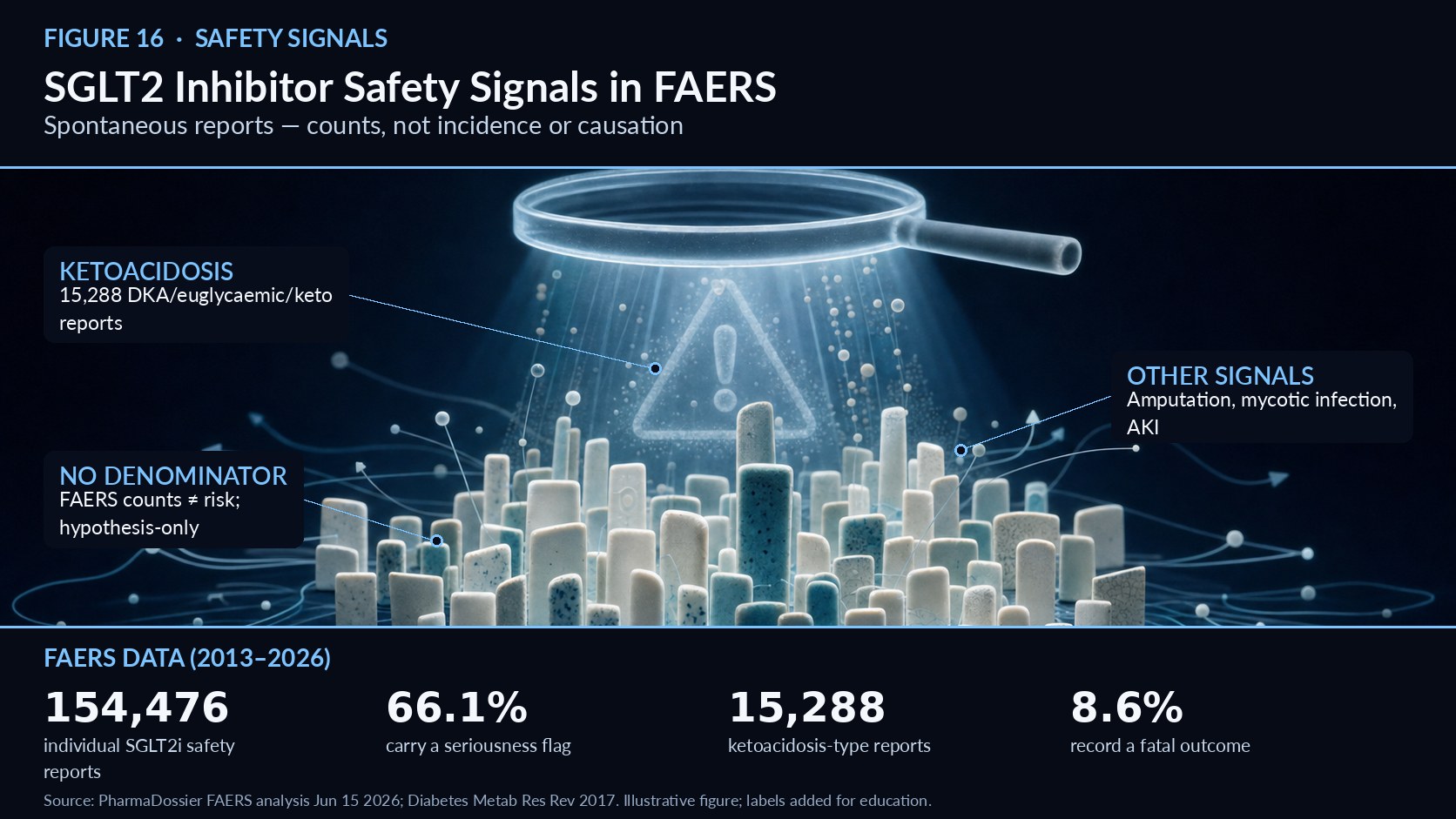

SGLT2 Inhibitor Safety Signals in FAERS Ketoacidosis and other adverse events across 154,476 spontaneous reports   Figure 16. SGLT2 Inhibitor Safety Signals in FAERS — mechanism overview (illustrative; labels added for education). A June 2026 analysis of the openFDA FAERS database offers a large-scale view of real-world SGLT2-inhibitor safety signals. The extract, dated 2026-06-08, holds 154,476 individual safety reports naming at least one of five SGLT2 inhibitors—empagliflozin, dapagliflozin, canagliflozin, ertugliflozin, and bexagliflozin—covering 2013 to early 2026.1 Overall severity is notable: of the class-level reports, 102,173 (66.1%) carry a seriousness flag and 13,310 (8.6%) record a fatal outcome.1 These proportions reflect reporting biases toward severe events but still merit clinical attention. Ketoacidosis is the signature signal. The database contains 9,278 reports of diabetic ketoacidosis, 3,108 of euglycaemic DKA, and 2,902 of ketoacidosis—15,288 combined—consistent with the mechanism of urinary glucose loss shifting metabolism toward ketogenesis.1 The euglycaemic subset is especially important because normal glucose can delay diagnosis. Other recognised signals appear in expected proportions: lower-limb amputation (4,819), genital mycotic infection (5,385), volume depletion or acute kidney injury (9,162), and the rare but severe Fournier’s gangrene / necrotising fasciitis (630).1 The comparison with an active-control analysis sharpens the signal: an earlier FAERS study estimated roughly seven-fold higher acidosis reporting for SGLT2 inhibitors versus DPP-4 inhibitors, with most quantifiable cases euglycaemic.2 That euglycaemic pattern is the practical danger—normal or near-normal glucose can falsely reassure both patient and clinician while ketoacidosis develops. Set against the class’s large, proven cardiorenal benefit, these disproportionality signals argue for structured patient education and sick-day planning, not for abandoning an otherwise foundational therapy.3 Interpreting these numbers requires caution. FAERS is a spontaneous-reporting system with no denominator, so counts are not incidence, relative risk, or causal estimates; the FDA first flagged ketoacidosis in a December 2015 Drug Safety Communication.1 An earlier FAERS analysis estimated a roughly seven-fold higher acidosis risk in type 2 diabetes patients on SGLT2 inhibitors versus DPP-4 inhibitors, with 71% of quantifiable cases euglycaemic—reinforcing vigilance around ketoacidosis in particular.2 For practice, the message is not to avoid these highly effective drugs but to counsel patients on sick-day rules, hold therapy around surgery or acute illness, and consider ketones whenever an SGLT2-treated patient is unwell, even with normal glucose. References 1. SGLT2 inhibitors in FAERS: 154,476 adverse-event reports by the numbers, PharmaDossier, June 15, 2026. https://pharmadossier.com/blog/sglt2-inhibitor-faers-adverse-events-by-the-numbers 2. Ketoacidosis associated with SGLT2 inhibitor treatment (FAERS), Diabetes Metab Res Rev, 2017. https://pmc.ncbi.nlm.nih.gov/articles/PMC5950709/ 3. Beyond Glucose Control: A Comprehensive Review of SGLT2 Inhibitors, Cureus, March 2, 2026. https://pmc.ncbi.nlm.nih.gov/articles/PMC12952939/ 4. Combining SGLT2 inhibitor and GLP-1 receptor agonist: a real-world FAERS study, ScienceDirect, Jan 2025. https://www.sciencedirect.com/science/article/pii/S0939475324003776 5. Disproportionality Analysis of Tirzepatide-Associated Ketoacidosis (FAERS), PubMed (PMID 42248357). https://pubmed.ncbi.nlm.nih.gov/42248357/ 6. Mechanisms of Action of SGLT2 Inhibitors, Am J Hypertens, 2024. https://pmc.ncbi.nlm.nih.gov/articles/PMC11471837/

Downloads

Published

2026-07-07

How to Cite

SGLT2 Inhibitor Safety Signals in FAERS Ketoacidosis and other adverse events across 154,476 spontaneous reports. (2026). Diabzen, 4(16), 32-33. https://thediabzen.com/index.php/d/article/view/59

Most read articles by the same author(s)

<< < 1 2 3 > >>