
Vol. 4 No. 1 (2026): The First-Ever 2026 CKM Syndrome Guideline
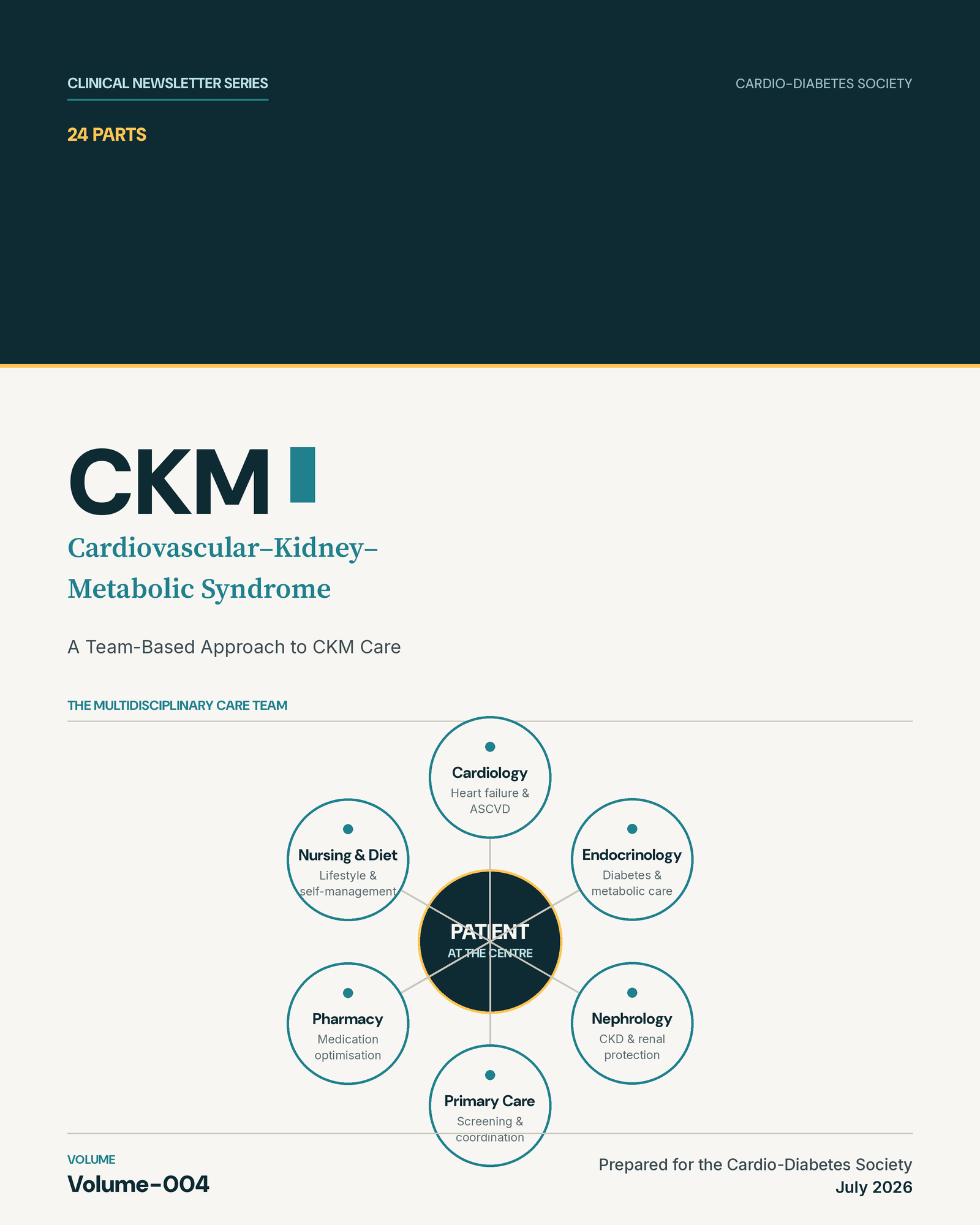
On June 9, 2026, the American Heart Association and American College of Cardiology published the first-ever clinical practice guideline dedicated to cardiovascular–kidney–metabolic (CKM) syndrome, simultaneously in Circulation and the Journal of the American College of Cardiology. It was developed with and endorsed by the American Diabetes Association, the ADA Obesity Association, and the American Society of Nephrology, making it a genuinely cross-specialty document.1 CKM syndrome is defined as an interrelated disorder characterised by the tight biological connections among metabolic risk factors—including obesity and type 2 diabetes—chronic kidney disease, and cardiovascular disease.2 Rather than treating each organ system in isolation, the guideline asks clinicians to see one continuum of shared pathophysiology in which dysfunction in one domain accelerates injury in the others. The scale of the problem is striking. Nearly 90% of U.S. adults have at least one CKM risk factor, roughly 15% are already in an advanced stage, and up to 90% of people with chronic kidney disease are unaware of their diagnosis.1,4 Those figures explain why the writing committee prioritised earlier screening, staging, and coordinated action over reactive, single-disease care. The guideline retires, replaces, and expands upon the 2013 Guideline for the Management of Overweight and Obesity in Adults—signalling a paradigm shift from a weight-centric view to a systems-level model of cardiometabolic health.2 Guideline chair Chiadi E. Ndumele put it plainly: “Heart, kidney, and metabolic conditions don’t occur in isolation—they are deeply connected. This guideline calls for earlier screening and care, focusing on prevention and coordinated action.”1 The document is also notable for who wrote it. Because it was co-developed and endorsed by the ADA, the ADA Obesity Association, and the American Society of Nephrology, its recommendations carry unusual cross-specialty authority—a cardiologist, nephrologist, and endocrinologist can now point to the same source when coordinating care.1 The accompanying “Top Things to Know” summary distils the full text into ten actionable messages, making it practical to translate the guideline into audit criteria and clinical checklists at the point of care.3 For clinicians in India, where diabetes and CKD prevalence are high and often diagnosed late, the framework is directly relevant: it offers a shared vocabulary across cardiology, nephrology, endocrinology, and primary care, and a staging system that can be implemented with basic laboratory testing. The formal citation is Ndumele CE, Rodriguez F, Dixon DL, et al., JACC, published online June 9, 2026, doi:10.1016/j.jacc.2026.03.056.2 References 1. First-ever guideline on CKM syndrome issued, AHA Newsroom, June 9, 2026. https://newsroom.heart.org/news/first-ever-guideline-on-cardiovascular-kidney-metabolic-syndrome-issued 2. First-Ever Guideline Addresses CKM Syndrome, ACC.org Journal Scan, June 9, 2026. https://www.acc.org/latest-in-cardiology/journal-scans/2026/06/08/17/44/first-ever-guideline-addresses-ckm-syndrome 3. 2026 CKM Guideline — Top Things to Know, professional.heart.org, June 9, 2026. https://professional.heart.org/en/science-news/2026-guideline-for-the-prevention-detection-evaluation-and-management-of-ckm-syndrome/top-things-to-know 4. A new guideline links care for heart, kidney and metabolic diseases, Science News, June 10, 2026. https://www.sciencenews.org/article/heart-diabetes-kidney-disease-treatment 5. New guideline reframes weight as health risk, AHA Newsroom, June 9, 2026. https://newsroom.heart.org/news/new-guideline-reframes-weight-as-health-risk-tied-to-diabetes-kidney-and-heart-conditions 6. The Role of GLP-1 Receptor Agonists in the Treatment of CKM Syndrome, JACC Adv, Jan 2026 (PMID 41609289). https://pubmed.ncbi.nlm.nih.gov/41609289/
Description

This newsletter summarizes the first-ever 2026 CKM syndrome guideline, a landmark cross-specialty framework jointly developed by the AHA, ACC, ADA, and ASN. It explains how cardiovascular, kidney, and metabolic diseases are linked through shared biology, why earlier screening and staging are now emphasized, and how the guideline shifts practice away from isolated organ-based care toward coordinated prevention and treatment. The article also highlights its relevance for India, where late diagnosis and high cardiometabolic burden make a unified clinical approach especially important.

Published: 2026-07-07