

Weight Regain After Stopping GLP-1s Why obesity pharmacotherapy is long-term, disease-modifying treatment

Authors

  • Dr Ashutosh Mishra english Author

Keywords:

Weight regain after discontinuation, GLP‑1 receptor agonists, Adaptive thermogenesis, Chronic obesity therapy, Cardiometabolic reversal

Abstract

Abstract

Background: As GLP‑1 and multiagonist therapies become widespread, clinicians need clear evidence on the consequences of discontinuation. This synthesis examines trial data and mechanisms behind weight regain after stopping incretin‑based obesity treatments.

Methods and scope: We review extensions and randomized discontinuation trials (STEP‑1 extension, STEP‑4, SURMOUNT‑4) that explicitly compare continued therapy with placebo switch after initial weight loss, and summarise mechanistic explanations for relapse.

Findings: Discontinuing GLP‑1 or dual/triple agonists reliably triggers clinically meaningful weight regain. In the STEP‑1 extension (n=327), mean weight change fell from −17.3% at week 68 to −5.6% at week 120 after stopping semaglutide—about two‑thirds of the weight lost was regained within a year. STEP‑4 (n=803) showed a 14.8 percentage‑point between‑arm difference driven by continued loss versus regain. SURMOUNT‑4 demonstrated an even larger effect: after open‑label tirzepatide (mean −20.9%), continued therapy achieved a further −5.5%, while placebo‑switch participants regained +14.0% over 52 weeks. Cardiometabolic improvements tracked weight: waist circumference, blood pressure, HbA1c, and lipids regressed with weight rebound. Mechanistically, appetite suppression wanes within weeks (roughly five half‑lives for semaglutide), while compensatory physiology—adaptive thermogenesis and counter‑regulatory hormonal changes (↑ghrelin, ↓leptin and PYY)—actively defends a higher adiposity set point.

Conclusions: The reproducible rebound after stopping therapy underscores that GLP‑1 treatments are chronic, disease‑modifying interventions rather than short courses. Clinicians should counsel patients on the expected need for long‑term therapy, incorporate monitoring and safety planning, and consider cost/access implications—particularly in resource‑constrained settings where stopping therapy risks rapid health reversal.
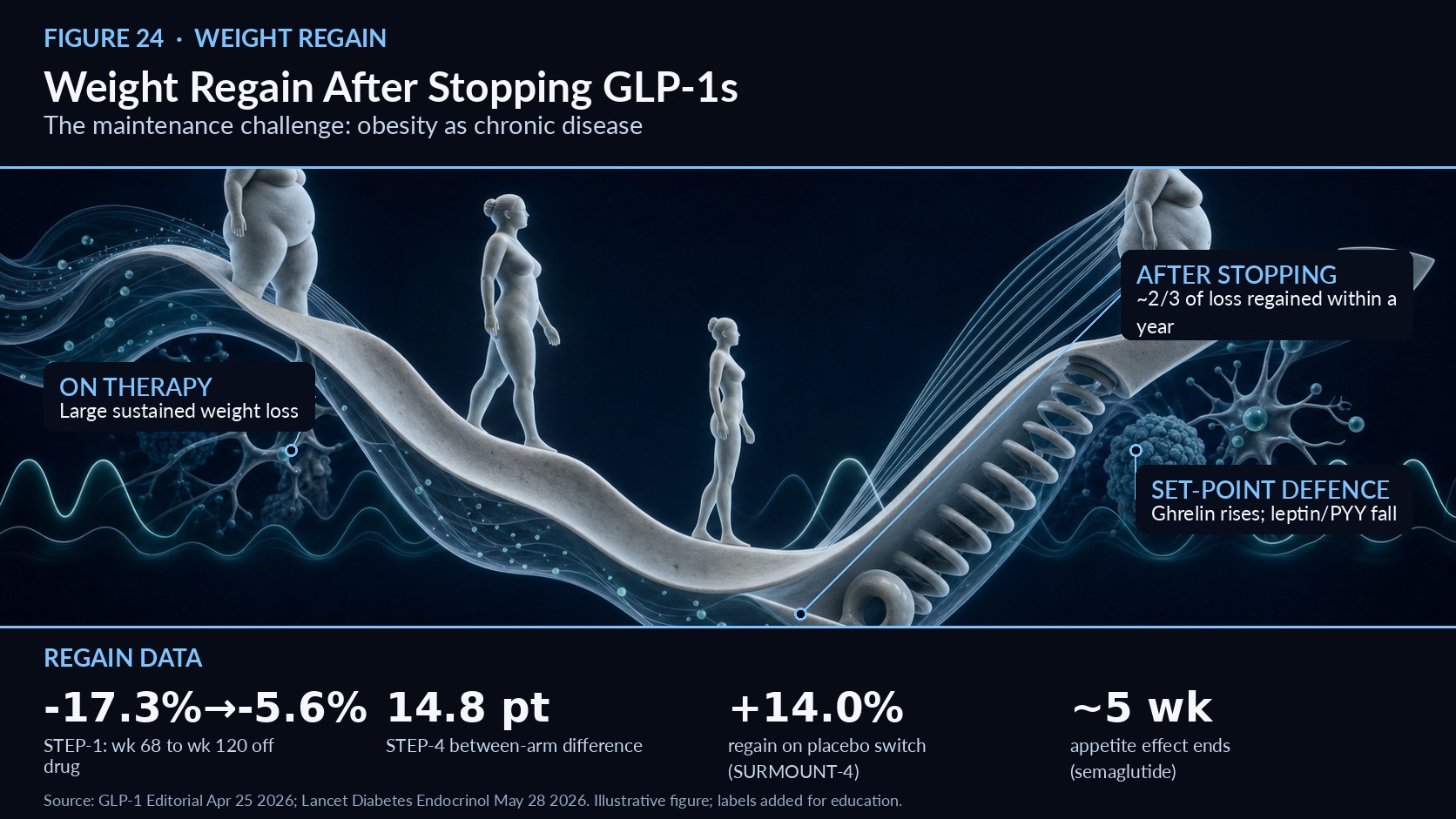
NEWSLETTER 24 Weight Regain After Stopping GLP-1s Why obesity pharmacotherapy is long-term, disease-modifying treatment   Figure 24. Weight Regain After Stopping GLP-1s — mechanism overview (illustrative; labels added for education). One of the most clinically important lessons of the GLP-1 era is what happens when treatment stops. In the STEP-1 extension (327 participants), the semaglutide arm’s weight change went from −17.3% at week 68 to −5.6% at week 120 after stopping—meaning patients regained about two-thirds of their prior weight loss within one year.1 Discontinuation, in other words, largely undoes the gains. Controlled comparisons make the effect unmistakable. In STEP-4, where 803 patients were randomised after a 20-week titration (mean −10.6%), continued semaglutide produced 7.9% additional loss while the placebo-switch arm regained 6.9%—a 14.8 percentage-point between-arm difference.1 In SURMOUNT-4, after 36 weeks of open-label tirzepatide (mean −20.9%), continued tirzepatide lost a further 5.5% while the placebo-switch arm regained 14.0% over 52 weeks.1 The rebound is not merely cosmetic. Cardiometabolic gains—waist circumference, blood pressure, HbA1c, and lipids—reverted in parallel with weight regain after discontinuation, erasing much of the organ-level benefit that motivated treatment.1 The mechanisms explain the speed and consistency of relapse. Appetite suppression ends within roughly four to five half-lives (about five weeks for semaglutide), and adaptive thermogenesis, rising ghrelin, and falling leptin and PYY actively defend a lower set point—biology, not willpower, drives the regain.1 The consistency across three separate trials—STEP-1, STEP-4, and SURMOUNT-4—is what makes the finding so robust: whenever the drug was withdrawn, weight and cardiometabolic markers moved back toward baseline, regardless of agent or starting point.1 This argues strongly against using GLP-1 therapy as a time-limited “kickstart.” Instead it should be planned, resourced, and consented to as ongoing treatment, with clinicians setting realistic expectations about duration and cost from the very first prescription.2 This maintenance challenge reframes how these drugs should be used. It underscores the 2026 guideline’s framing of obesity pharmacotherapy as long-term, disease-modifying therapy rather than a short course—analogous to antihypertensives, which are not stopped once blood pressure normalises.2 For clinicians and patients in India navigating cost and access, this evidence is essential for setting expectations: planning for sustained therapy, budgeting accordingly, and avoiding the disappointment and health reversal that follow abrupt discontinuation.3 References 1. Weight Regain After Stopping Semaglutide or Tirzepatide: STEP-1 Extension and STEP-4 Data, GLP-1 Editorial, April 25, 2026. https://glponeeditorial.com/clinical/glp1-rebound-weight-regain 2. Beyond weight loss: multisystem benefits of obesity medications, Lancet Diabetes Endocrinol, May 28, 2026 (PMID 42208956). https://pubmed.ncbi.nlm.nih.gov/42208956/ 3. New guideline reframes weight as health risk, AHA Newsroom, June 9, 2026. https://newsroom.heart.org/news/new-guideline-reframes-weight-as-health-risk-tied-to-diabetes-kidney-and-heart-conditions 4. Incretin-Based Therapies Through the Decades, Med Sci (PMC), Nov 14, 2025. https://pmc.ncbi.nlm.nih.gov/articles/PMC12641833/ 5. What the GLP-1 Pipeline Showed at ADA 2026, PeptidePrices, June 9, 2026. https://peptideprices.net/blog/ada-2026-glp1-pipeline-roundup 6. 2026 CKM Guideline — Top Things to Know, professional.heart.org, June 9, 2026. https://professional.heart.org/en/science-news/2026-guideline-for-the-prevention-detection-evaluation-and-management-of-ckm-syndrome/top-things-to-know

Downloads

Published

2026-07-07

How to Cite

Weight Regain After Stopping GLP-1s Why obesity pharmacotherapy is long-term, disease-modifying treatment. (2026). Diabzen, 4(24), 48-49. https://thediabzen.com/index.php/d/article/view/67

Most read articles by the same author(s)

<< < 1 2 3 > >>